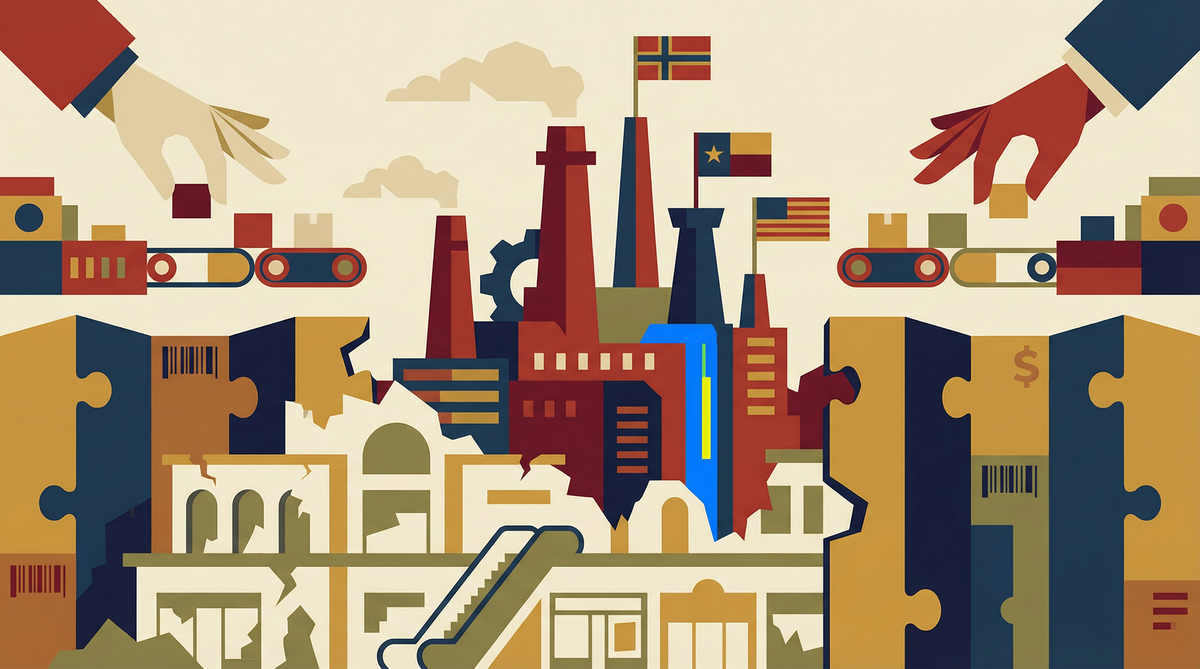
In February 2026, the United States finalised a trade deal with Taiwan that set tariffs at 15%, secured $250 billion in corporate investment pledges for American semiconductor and AI production, and included $84 billion in Taiwanese purchases of American goods. The deal was, in effect, a mercantilist bargain dressed in the language of free trade: you build your factories here, you buy our energy, and we will let your goods in at a price that does not destroy our own industries.
This would have been unthinkable a decade ago. For forty years, the dominant economic orthodoxy in the West held that manufacturing did not matter. What mattered was services, finance, intellectual property, and the “knowledge economy.” Making physical things was for developing countries with cheap labour. The West would design, brand, and market. Others would build.
That orthodoxy is now dead. Tariffs are back. Industrial policy is back. Subsidies are back. Every serious nation on Earth — the United States, the European Union, Japan, South Korea, India — is scrambling to rebuild domestic manufacturing capacity in semiconductors, batteries, pharmaceuticals, defence equipment, and critical minerals. Morgan Stanley has called 2026 an inflection point for American manufacturing transformation. Over 2.5 million jobs have been reshored or created through foreign direct investment in the US since 2010, with 2023 and 2024 recording the highest annual totals ever.
This is not a temporary policy fad. It is a return to the historical norm. For most of the past five centuries, every nation that became powerful did so by protecting and building its domestic manufacturing base. The brief period of genuine free trade enthusiasm — roughly 1980 to 2015 — was the aberration, not the rule. Understanding why requires going back to the beginning.
Part 1: The Mercantilist Foundations of Western Power
The story of Western economic dominance begins not with free trade but with its opposite: state-directed, protectionist, mercantilist industrial policy.
In the 1400s and 1500s, European merchants banded together to form joint stock companies that were granted monopoly rights over specific markets and regions by their governments. The English East India Company, established in 1600, eventually came to dominate the Indian subcontinent. The Dutch East India Company (VOC) controlled the spice trade. The Virginia Company colonised the eastern seaboard of North America. The French, Portuguese, Spanish, and Scandinavians all had equivalent organisations.
These companies were violently anti-competitive. Going abroad was expensive and dangerous. Once a trading post was established, the last thing any company wanted was a competitor showing up. They maintained private armies and armed merchantmen to enforce their monopolies. The state was fully behind this: colonies existed to supply raw materials and to serve as captive markets for the mother country’s manufactured goods.
This was not an accident or a moral failing. It was a rational strategy for wealth accumulation. Raw materials are cheap. Manufactured goods are expensive. If you can force your colonies to sell you cheap cotton and buy back expensive cloth, you capture the value added by manufacturing. The wealth differential compounds over time. This is how tiny European nations came to dominate continents with vastly larger populations.
The American colonies experienced this system from the receiving end. All shipping to North America had to be carried on British ships. The manufacture of many goods was banned in the colonies. George Washington’s personal correspondence is full of complaints about the high cost, low quality, and late delivery of goods from England. One of the principal economic grievances behind the American Revolution was the mercantilist system itself — the colonists wanted to manufacture their own goods and trade freely with whomever they chose.
Part 2: Hamilton’s Playbook — How America Built Itself
What happened after American independence is one of the most important and least understood episodes in economic history. The United States did not embrace free trade. It did the opposite.
Alexander Hamilton, the first Secretary of the Treasury, submitted his “Report on Manufactures” to Congress in 1791. It is one of the most consequential economic documents ever written, and it explicitly rejected the free trade theories of Adam Smith. Hamilton argued that a young nation could not compete against established industrial powers on equal terms. British manufacturers had decades of accumulated expertise, capital, and scale. American manufacturers had none of these things. In a free market, British goods would flood America, American infant industries would be crushed in the cradle, and the United States would remain a raw materials exporter — a colony in all but name.
Hamilton’s solution was comprehensive: high tariffs on imported manufactured goods, government subsidies for domestic manufacturers, investment in infrastructure (roads, canals, ports), and the active recruitment of skilled workers and industrial secrets from Britain. He understood that manufacturing was not just about economics. It was about national sovereignty. A nation that cannot make its own goods cannot arm its own soldiers, equip its own navy, or sustain itself in a crisis.
Congress adopted Hamilton’s programme. The United States became the most protectionist major economy in the world and remained so for over 150 years. Average US tariff rates on manufactured goods ranged from 35% to 50% for most of the period between 1816 and 1945. During this time, the United States went from a marginal agricultural economy to the largest industrial power on Earth.
This was not a coincidence. It was the plan.
Free trade economists dismiss this as the “infant industry” argument and claim it is a smoke screen — that protected industries never grow up. Milton Friedman wrote in 1980 that “the so-called infants never grow up. Once imposed, tariffs are seldom eliminated.” He was looking at the wrong nurseries. South Korea’s automobile industry was protected by import bans and tariffs from the 1960s. Hyundai exported its first car to the United States in 1986. By 2024, Hyundai-Kia was the world’s third-largest automaker. The infant grew up. Japan’s semiconductor industry was nurtured behind tariff walls and MITI guidance in the 1960s and 1970s. By the 1980s, Japanese firms held over 50 per cent of the global DRAM market. The infant graduated. China’s solar panel industry received state subsidies and tariff protection from 2005. By 2024, Chinese firms produced over 80 per cent of the world’s solar panels at costs no Western manufacturer could match. The infant now dominates the global market. What Friedman observed was not that infant-industry protection fails, but that the West practised it badly — half-heartedly, without strategic direction, captured by incumbents seeking permanent rent rather than temporary shelter. The Asian tigers did it differently: protection was conditional on performance. Meet the export targets or lose the subsidy. That discipline was the difference between Hamilton’s vision and the pork-barrel protectionism that gave the policy a bad name.
The German economist Friedrich List, writing in the 1840s, made the same argument even more forcefully. List had lived in the United States and had seen Hamilton’s system in action. He returned to Germany and argued that free trade was a strategy employed by already-industrialised nations to prevent others from catching up. Britain, he noted, had used protectionism and state support to build its industrial base, and only began advocating free trade once it had an unbeatable competitive advantage. Free trade, List wrote, was “kicking away the ladder” — climbing to the top using protectionist policies and then telling everyone else that ladders were inefficient.
List’s analysis was devastatingly accurate. Britain only became a champion of free trade after the Industrial Revolution had given it manufacturing capabilities that no other nation could match. If you can produce goods that are cheaper, better, and in greater quantities than anyone else, you effectively have a monopoly. The only thing preventing you from selling everywhere is other countries’ tariff barriers. So you campaign to tear those barriers down — not because you believe in free competition, but because you know you will win.
Part 3: The Free Trade Aberration (1945–2015)
If protectionism built every major industrial power in history, why did the West abandon it?
The answer is the Cold War. After 1945, the United States found itself in an existential struggle with the Soviet Union. America needed allies — lots of them, quickly. The most effective way to bind nations to the Western bloc was through economic integration. The Marshall Plan rebuilt Western Europe. The General Agreement on Tariffs and Trade (GATT) and later the World Trade Organisation (WTO) progressively lowered trade barriers. The United States deliberately opened its domestic market to allies like Japan, South Korea, Taiwan, and West Germany, accepting trade deficits as the price of geopolitical loyalty.
This was not free trade in any classical sense. It was a strategic subsidy. America was trading manufacturing jobs for military alliances. For as long as the Soviet threat existed, this bargain made sense. American workers who lost factory jobs could find employment in the expanding service sector, and the geopolitical benefits of a united Western bloc outweighed the economic costs.
The collapse of the Soviet Union in 1991 should have prompted a reassessment of this bargain. Instead, it produced a burst of ideological triumphalism. Free trade was no longer a Cold War strategy — it became an article of faith. Francis Fukuyama declared the “end of history.” The Washington Consensus promoted trade liberalisation, deregulation, and privatisation as universal prescriptions for economic development. China was admitted to the WTO in 2001 on the assumption that trade would liberalise its political system.
Manufacturing as % of GDP: The West vs China
Western nations hollowed out their manufacturing base while China built the largest industrial economy in history
Source: World Bank, National Bureau of Statistics of China, OECD
Western companies rushed into China, eager to exploit cheap labour. They built factories, trained Chinese workers, transferred technology — sometimes voluntarily, sometimes under coercion from the Chinese government, which required joint ventures and technology sharing as conditions of market access. For a brief period, the arrangement appeared to work. Western consumers got cheap goods. Chinese workers got jobs. Everyone seemed to be getting richer.
But the theory of comparative advantage, which underpinned this system, assumed that countries would specialise in what they were good at. China was supposed to make cheap toys and textiles. The West was supposed to make advanced technology and provide high-value services. Instead, China systematically moved up the value chain. One by one, Chinese companies — backed by massive state subsidies, cheap credit, and stolen intellectual property — began to dominate sector after sector: steel, solar panels, shipbuilding, telecommunications equipment, electric vehicles, batteries, and increasingly semiconductors and artificial intelligence.
By 2018, China was the world’s largest manufacturer and the world’s largest exporter. The theory of comparative advantage had not just failed. It had been weaponised against the nations that believed in it.
Part 4: The Reckoning
The consequences of forty years of deindustrialisation are now impossible to ignore.
When Russia invaded Ukraine in 2022, the European Union pledged to deliver one million artillery shells to Ukraine within a year. It could not meet the target. Europe’s combined GDP was over ten times Russia’s, but it could produce a fraction of Russia’s military output. The problem was not money. It was capacity. The factories, the skilled workers, the supply chains — all had been dismantled during three decades of “peace dividend” and offshoring.
The United States discovered similar vulnerabilities. During the COVID-19 pandemic, America could not produce enough surgical masks, ventilators, or basic pharmaceuticals. The richest nation in history was dependent on China for the most elementary medical supplies. The strategic implications were obvious and terrifying: in a serious conflict with China, the United States would be fighting a war while dependent on its adversary for critical supplies.
Thomas Sowell observed decades ago that the real cost of a policy is not what it costs in money but what it costs in alternatives foregone. The real cost of free trade was not measured in cheaper consumer goods. It was measured in the millions of manufacturing jobs lost, the communities hollowed out, the skills that disappeared, the supply chains that moved offshore, and the strategic dependencies that were created. The cheap television from China cost less at the checkout. But the factory that closed, the town that died, the workers who never found equivalent employment, the tax base that evaporated, and the military vulnerability that was created — these costs were never on the price tag.
Part 5: The Return
What is happening now is not a policy experiment. It is a correction — a return to the historical norm after a forty-year aberration.
The United States has imposed tariffs on Chinese goods ranging from 15% to over 100% on specific categories. The CHIPS Act provides $52 billion in subsidies for domestic semiconductor manufacturing. The Inflation Reduction Act channels hundreds of billions into domestic clean energy manufacturing. The US-Taiwan deal of February 2026 is explicitly designed to bring semiconductor production onto American soil.
Europe is following, albeit more slowly. The EU’s European Chips Act aims to double Europe’s share of global semiconductor production. Individual nations are offering subsidies to attract battery factories, pharmaceutical plants, and defence manufacturers. Even Germany, the high priest of free trade within Europe, has begun to talk about “strategic autonomy” and “de-risking” supply chains.
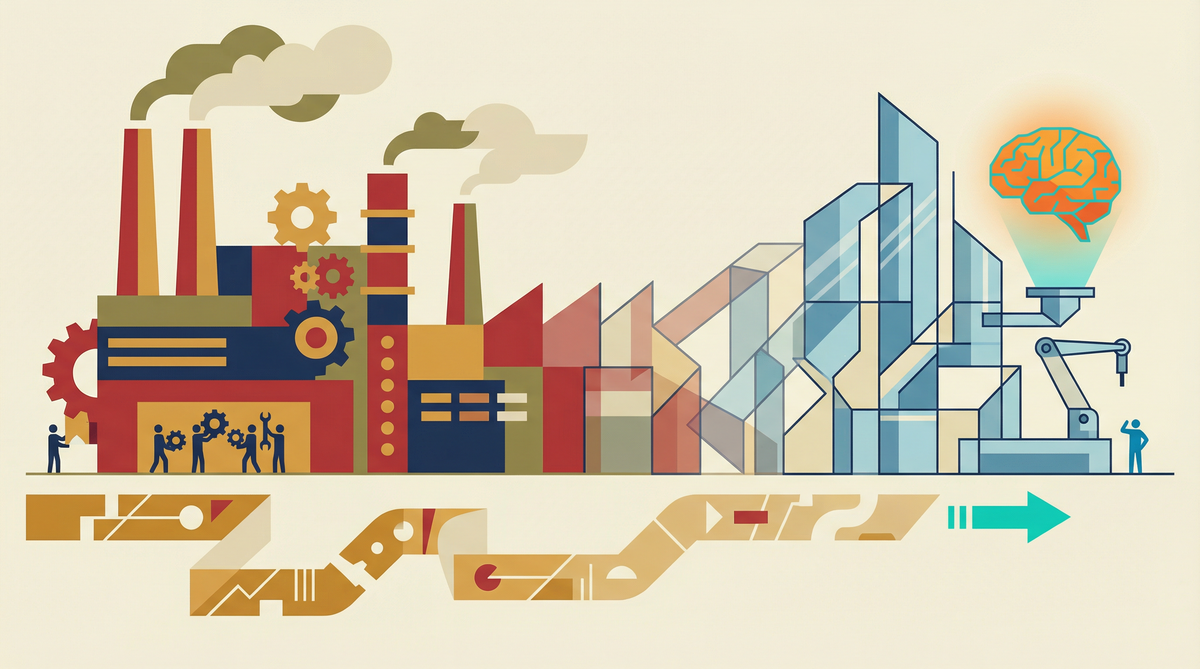
The critical enabler of this reshoring revolution is technology. In the 1990s and 2000s, the economic case for offshoring was simple: labour in China cost a fraction of labour in the West, and the savings more than offset the costs of shipping goods across the Pacific. But AI and robotics are rapidly eliminating the labour cost advantage. A factory staffed by robots costs roughly the same to operate whether it is in Ohio or Guangdong. If the labour cost differential disappears, the case for manufacturing close to the end consumer — avoiding shipping costs, tariff risks, supply chain disruptions, and geopolitical dependencies — becomes overwhelming.
Morgan Stanley analysts predict that 2026 marks an inflection point: companies are first investing in automation and productivity upgrades to maximise existing facilities, positioning themselves for larger greenfield factory construction as the economics shift decisively in favour of domestic production.
Part 6: What Comes Next
History suggests where this leads.
The 2020s through the 2040s will see a return to something resembling nineteenth-century industrial policy across the developed world. Tariffs, subsidies, state-directed investment in strategic sectors, and active efforts to recruit or develop critical technologies will become the norm, not the exception. The language will be different — “strategic autonomy,” “supply chain resilience,” “friend-shoring” — but the substance will be the same mercantilism that Hamilton, List, and Colbert would recognise instantly.
Nations that rebuild their manufacturing base will find themselves stronger, more resilient, and more sovereign. They will be able to arm their own militaries, supply their own hospitals, and sustain their own populations in a crisis. They will also find that manufacturing creates a virtuous cycle: factories require skilled workers, skilled workers require education and training, education and training create innovation, and innovation creates new industries. This is the cycle that made Britain, America, Germany, and Japan great. It is the cycle that China has been running for thirty years while the West was busy congratulating itself on its service economy.
Nations that fail to rebuild will find themselves in the position of late Rome: wealthy on paper, dependent on others for the goods they need, and strategically vulnerable to any disruption in the supply of those goods. Rome did not fall because it was poor. It fell because it had outsourced its military to Germanic mercenaries and its agriculture to slave-worked latifundia, and when the system was disrupted, there was nothing underneath.
The Ricardian theory of comparative advantage will not disappear from economics textbooks. But it will increasingly be taught as a historical curiosity — a theory that described a brief and unusual period in which one group of nations was so dominant that they could afford to pretend that the rules did not apply to them. The rules always applied. They just took forty years to reassert themselves.
The factories are coming back. The question is not whether, but which nations will build them fast enough.