In February 2026, Mustafa Suleyman, the CEO of Microsoft AI, predicted that “most, if not all” white-collar tasks would be fully automated by artificial intelligence within twelve to eighteen months. He specifically named lawyers, accountants, project managers, and marketing professionals as roles that would be substantially replaced. His prediction may prove optimistic on the timeline, but the direction is not in doubt. AI systems are already writing legal briefs, processing tax returns, generating marketing copy, diagnosing diseases, and writing software code — tasks that, five years ago, were considered safely beyond the reach of machines.
In the same month, in the same world, South Korea reported that its fertility rate had fallen to 0.72 children per woman — the lowest ever recorded by any nation in human history. Japan continued to sell more adult incontinence products than baby nappies. Spain reported entire villages where the youngest resident was over sixty. China, which once punished families for having a second child, was now offering cash bonuses for a third. The bonuses were not working.
These two facts — the explosion of artificial intelligence and the implosion of human fertility — are usually discussed as separate stories. They are not. They are two halves of the same story, and understanding how they fit together is the most important economic and political question of the twenty-first century.
Every developed nation on Earth faces a demographic crisis that no policy response has yet been able to solve. Birth rates are below replacement level everywhere. Populations are ageing. The ratio of working-age adults to retirees is collapsing. The welfare state, the pension system, the healthcare system, and the tax base all depend on there being enough young, productive workers to support a growing number of elderly dependents.
The standard response has been mass immigration. The logic is straightforward: if your own citizens will not have enough children, import young workers from countries that still do. This has been the de facto policy of virtually every Western government for the past three decades.
Fertility Rates vs Robot Density: The Two Paths
Nations with the lowest fertility rates are investing most heavily in robots — Japan and South Korea lead both trends
Source: UN Population Division (2024); International Federation of Robotics, World Robotics Report 2025
History Future Now has written extensively about why this does not work. This article takes the argument to its conclusion: there is now an alternative. That alternative is the robot. And the choice between the immigrant and the robot will define the political, economic, and cultural trajectory of every developed nation for the next fifty years.
Part 1: Rome’s Labour Crisis
The demographic crisis facing the modern West is not unprecedented. The Roman Empire faced an almost identical problem two thousand years ago — and its response to that problem ultimately destroyed it.
By the first century BC, Roman citizens were having fewer children. Augustus, the first emperor, was so alarmed that in 18 BC he passed the Lex Julia de Maritandis Ordinibus — a comprehensive package of laws designed to encourage marriage and childbearing. Unmarried citizens were penalised. Parents of three or more children received tax breaks and preferential access to public office. Adultery was criminalised. Augustus understood that the legions, the tax base, and Roman identity itself depended on Romans producing the next generation.
The laws failed. Roman citizens continued to have fewer children. The reasons were strikingly similar to those driving modern fertility decline: rising costs of child-rearing, alternative lifestyles, urbanisation (which reduces the economic value of children), and a cultural shift toward individual fulfilment over familial duty.
Rome’s response to this labour shortage set in motion the chain of events that would eventually destroy the Western Empire. Unable to recruit enough Roman citizens for the legions, the empire increasingly relied on Germanic foederati — allied barbarian warriors who served in exchange for land, money, and the right to settle within the empire’s borders. Unable to find enough Roman workers for its farms and workshops, the empire relied on slaves and, later, on settled barbarian communities.
For a while, this worked. The Germanic soldiers were often excellent fighters. The settled communities paid taxes and contributed to the economy. But the foederati had their own leaders, their own loyalties, and their own interests. They were not Romans. They did not share Roman culture, Roman law, or Roman identity. As their numbers grew, the empire became increasingly dependent on people who had no fundamental attachment to the thing they were defending.
By the fifth century, the Roman army was largely Germanic. Many of the empire’s top military commanders were of barbarian origin. The people who controlled the military were not the people who had built the civilisation. When the system came under pressure — as it did with the Hunnic invasions and the cascading crises of the fifth century — the foederati made their own arrangements. The last Western Roman emperor was deposed in 476 AD by Odoacer, a Germanic chieftain who had been serving in the Roman army. The empire had been replaced from within by the very people it had imported to sustain itself.
Part 2: The Ottoman Millet System
The Ottoman Empire took a different approach to managing its multi-ethnic population, and the results were equally instructive.
The millet system divided Ottoman society into self-governing religious communities — the Muslim millet, the Greek Orthodox millet, the Armenian millet, the Jewish millet, and others. Each millet was governed by its own religious leaders according to its own laws in matters of personal status (marriage, divorce, inheritance, education). The communities coexisted within the same empire but lived largely separate lives.
For centuries, this system provided stability. The Ottoman Empire was one of the most successful multi-ethnic polities in history, controlling southeastern Europe, the Middle East, and North Africa for over 600 years. But the millet system contained the seeds of its own destruction: by keeping communities separate and allowing them to maintain distinct identities, it ensured that when the pressures of modernity arrived — nationalism, mass literacy, democratic ideas — each community had the cultural infrastructure to demand its own nation-state.
The nineteenth century saw one millet after another break away. Greece won independence in 1830. Serbia, Romania, and Bulgaria followed. The Arab Revolt of 1916–1918 detached the Middle East. The Balkan Wars of 1912–1913 stripped the empire of almost all its European territory. The empire that had managed diversity through separation was torn apart by the very identities it had preserved.
The parallel with modern multiculturalism is uncomfortable but direct. Western nations have, since the 1960s, adopted an approach to immigration that resembles the millet system: distinct communities are encouraged to maintain their own cultural identities, languages, religious practices, and social norms within the borders of the host nation. The assumption is that these communities will coexist harmoniously under a shared civic framework. But if the Ottoman experience is any guide, communities that maintain strong separate identities within a single polity will eventually assert those identities against the polity itself — especially when they reach sufficient demographic weight.
Part 3: The British Empire’s Indentured Labour Legacy
After the abolition of slavery throughout the British Empire in 1833, plantation owners in the Caribbean, Fiji, South Africa, Malaysia, and elsewhere faced an acute labour shortage. The former slaves, unsurprisingly, were not eager to continue working on the same plantations under only marginally better conditions.
The solution was indentured labour from India. Between 1834 and 1920, approximately 2 million Indians were transported to British colonies around the world under contracts that bound them to work for a fixed period (usually five years) in exchange for passage, food, and a small wage. The system was, in many respects, slavery by another name — the conditions were harsh, the contracts were coercive, and the workers had few practical rights.
The short-term economic problem was solved. The plantations had their labour. The sugar, tea, rubber, and other commodities continued to flow. The colonial economies functioned.
The long-term consequences are still with us. In Fiji, the Indian-descended population grew to nearly 50% of the total, creating ethnic tensions that have produced four coups since 1987. In Trinidad and Tobago, the population is roughly evenly split between African-descended and Indian-descended communities, with politics organised almost entirely along ethnic lines. In Guyana, the same ethnic division has produced chronic political instability. In Malaysia, the relationship between the Malay majority and the Indian and Chinese minorities remains a central fault line in national politics.
In every case, the labour shortage was solved. In every case, the solution created a permanent ethnic division that has proved impossible to resolve. The descendants of the imported workers did not assimilate. They maintained their own identities, their own communities, and their own political interests. The host societies were permanently transformed — not in the way that anyone planned, and not in a way that anyone would have chosen.
Part 4: Japan’s Choice
Japan’s post-war approach to the same set of challenges provides the single most important counter-example in modern history.
Japan faced, and faces, the same demographic crisis as every other developed nation: a fertility rate well below replacement (currently 1.20), a rapidly ageing population, and a shrinking workforce. The economic pressures are identical to those in Europe and the United States. The demand for labour — in manufacturing, eldercare, agriculture, and services — is acute and growing.
But Japan made a different choice. Where other nations imported workers, Japan imported machines. Japan has the highest robot density in the world — 399 industrial robots per 10,000 manufacturing workers, compared to 285 in Germany and 255 in the United States. Japanese companies are world leaders in industrial automation, and the Japanese government has actively promoted robotics as the solution to labour shortages since the 1980s.
Japan also maintained extremely restrictive immigration policies. Foreign-born residents constitute less than 3% of Japan’s population, compared to 14% in the United States, 15% in Germany, and over 20% in Switzerland and Australia. This was a deliberate choice, made consistently across decades by governments of different political orientations.
The results are debatable. Japan’s economic growth has been sluggish since the 1990s — the “Lost Decades” — and its GDP per capita has fallen relative to other developed nations. Critics argue that Japan’s restrictive immigration policy has contributed to this stagnation by limiting the labour supply and reducing the dynamism that immigrants bring.
But consider what Japan has preserved. Social cohesion remains extraordinarily high. Crime rates are among the lowest in the world. Trust in institutions, while declining, remains far higher than in most Western nations. There are no ethnic ghettos, no parallel societies, no identity-based political parties, no integration debates, and no terrorism driven by failures of assimilation. Japanese cities are safe, clean, and functional. The cultural identity of the nation is intact.
Thomas Sowell has argued that the economic contribution of immigrants is often overstated, while the social costs — wage depression for native workers, strain on public services, erosion of social trust — are systematically understated. Japan’s experience suggests that a nation can maintain a high standard of living, a functioning society, and a coherent national identity without mass immigration — provided it is willing to invest in the technology that replaces the labour that immigrants would have provided.
Part 5: The Robot Arrives
The technology that Japan pioneered is now reaching a tipping point that will transform the entire debate.
Industrial robots have been used in manufacturing since the 1960s. But they were expensive, inflexible, and limited to specific repetitive tasks in controlled environments. They could weld car panels and paint bodywork, but they could not care for an elderly person, stock supermarket shelves, or clean a hotel room.
That is changing with extraordinary speed. General-purpose humanoid robots — machines designed to operate in unstructured human environments, performing a wide range of physical tasks — are moving from science fiction to commercial reality.
Tesla’s Optimus robot is designed to perform tasks ranging from factory work to elder care, with a target price point below $20,000. Figure.ai’s Figure 01, backed by partnerships with OpenAI, demonstrates robots that can hold conversations while performing physical tasks. Unitree’s H1 holds the record for the fastest bipedal robot. Boston Dynamics’ Atlas can perform gymnastics that most humans cannot. Chinese companies, leveraging their dominance in electric vehicle manufacturing (which shares many components with humanoid robots), are entering the field rapidly.
At a price point of $20,000 or less — roughly equivalent to a year’s wages for a low-skilled worker in many Western countries — the economic case for humanoid robots becomes irresistible. A robot that costs $20,000, operates 24 hours a day, requires no salary, no benefits, no housing, no healthcare, no pension, and no return ticket is simply cheaper than any human worker, regardless of where that human comes from.
In parallel, AI is transforming white-collar work. Microsoft’s AI chief predicts automation of virtually all white-collar tasks within 18 months. Even if this timeline proves optimistic by a factor of five, the direction is clear. AI systems will progressively take over the cognitive tasks — legal research, financial analysis, medical diagnosis, software development, content creation — that have been the mainstay of middle-class employment in developed economies.
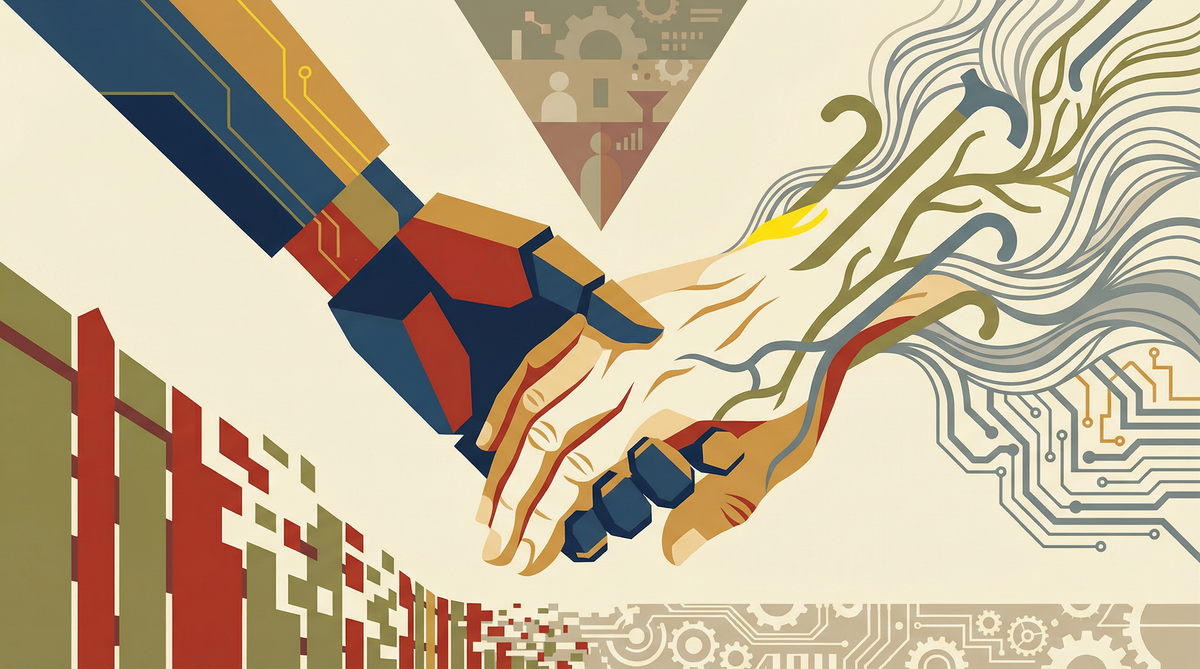
Together, humanoid robots and AI will provide an alternative to mass immigration that did not exist even a decade ago. The demographic crisis is real. The dependency ratio will not fix itself. Ageing nations need workers. But for the first time in history, those workers do not have to be human.
Part 6: What Comes Next
The 2030s will present every ageing nation with a binary choice that cannot be avoided or fudged: import people, or import robots.
There is no third option. The fertility rates are too low and have been too low for too long. No country in human history has recovered from a sustained fertility rate below 1.5. Pro-natalist policies — cash bonuses, tax breaks, subsidised childcare — have been tried in virtually every developed nation and have produced, at best, marginal and temporary increases. The demographic trajectory is set for the next thirty years, because the women who will be of childbearing age in 2040 have already been born — and there are not enough of them.
Nations that choose robots will face challenges. They will need to solve the problem of distributing the wealth that robots create — if robots produce the goods but do not earn wages, the old model of “work for money, money for goods” breaks down. New forms of taxation (perhaps a robot tax, or a tax on AI-generated productivity), new models of wealth distribution, and new conceptions of the purpose of human life in a post-labour economy will be required. These are serious challenges, but they are engineering problems with engineering solutions.
Nations that choose mass immigration will face the same fate as every multi-ethnic empire in history. The Roman foederati replaced the Romans. The Ottoman millets tore the empire apart. The British Empire’s indentured labour created permanent ethnic divisions. The pattern is consistent across millennia and civilisations: importing a large population with a different culture, language, religion, and identity to solve a short-term economic problem creates a long-term political and social problem that proves far more costly than the original economic challenge.
Moreover, the economic case for mass immigration is already weaker than its proponents claim — and the numbers are now specific enough to be devastating. A 2023 University of Amsterdam study using microdata on all 17 million Dutch residents found that the average asylum seeker costs the treasury €475,000 over their lifetime; immigrants from the Horn of Africa cost €606,000 per person. Total cost of immigration to the Netherlands between 1995 and 2019: approximately €17 billion per year. Denmark’s Ministry of Immigration reported that non-Western immigration cost the Danish state 31 billion DKK (€4.2 billion) in 2018 — in a country of fewer than six million people. The argument that immigration is necessary to sustain the welfare state is, in these cases, arithmetically backwards. The immigrants arriving cost more than they contribute. Immigration is not filling the demographic hole. It is making it deeper.
The robot bargain is this: accept the machine, maintain social cohesion, preserve cultural identity, and solve the distribution problem. Or accept the stranger, solve the immediate labour shortage, and inherit the ethnic, cultural, and political divisions that have destroyed every multi-ethnic polity in history.
Japan has shown that the first path is viable. Rome has shown where the second path leads.
The humanoid robot at $20,000 will make the economic argument for mass immigration completely obsolete within a decade. What will remain is a moral argument — that nations have an obligation to accept immigrants regardless of the consequences. That argument will be made. It will be made loudly and passionately. And it will lose, because democratic majorities in every developed nation have consistently shown that they prefer social cohesion, cultural continuity, and national identity to abstract moral obligations defined by people who do not bear the costs.
The robots are coming. They are coming faster than almost anyone expected. And they offer ageing nations something that no previous technology could: a way to solve the dependency crisis without importing the dependencies that destroyed Rome.
The choice, for the first time in two thousand years, is real. History suggests which option to take.