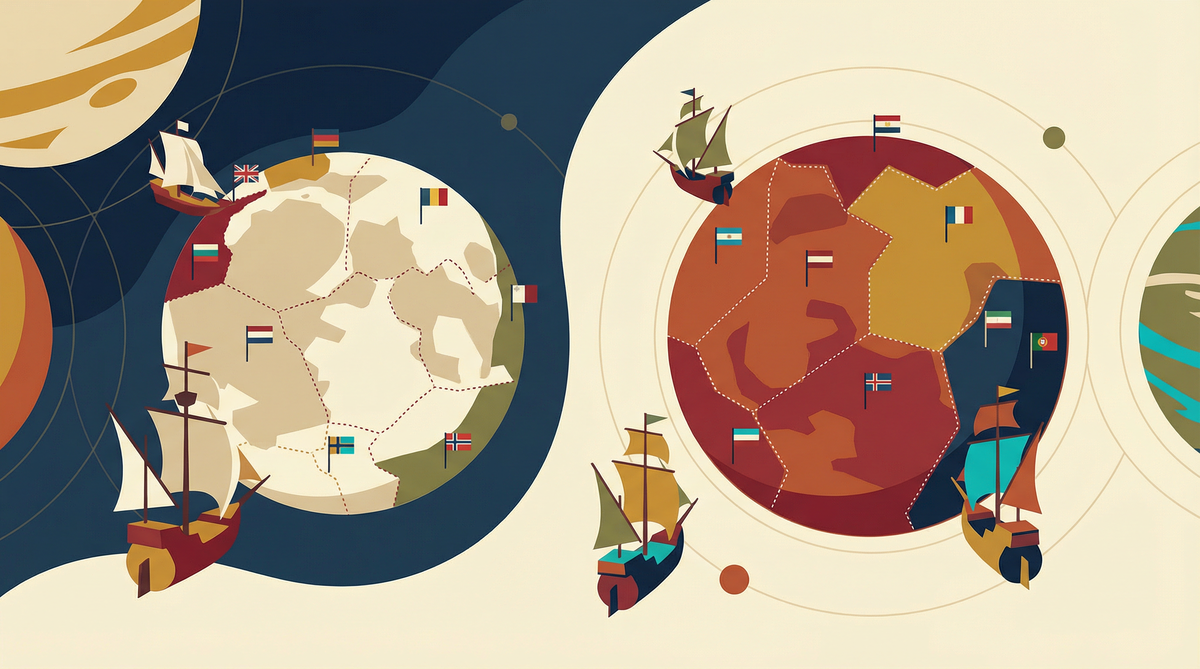
In 1494, Pope Alexander VI drew a line down the middle of the Atlantic Ocean. Everything to the west belonged to Spain. Everything to the east belonged to Portugal. The Treaty of Tordesillas, ratified by both crowns, was supposed to divide the undiscovered world between the two great Catholic maritime powers and prevent conflict over new territories.
It lasted about five minutes, historically speaking. England ignored it. France ignored it. The Netherlands ignored it. Every rising power that had the ships and the ambition to explore simply pretended the treaty did not exist. Within a century, the neat papal division of the world had been overtaken by the chaotic reality of competitive colonisation. The nations that got there first, built settlements, and defended them with force owned the territory. The treaty was a piece of paper. The cannon was the law.
The Outer Space Treaty of 1967 is the Treaty of Tordesillas of our time. It declares that outer space “is not subject to national appropriation by claim of sovereignty, by means of use or occupation, or by any other means.” No nation can own the Moon, Mars, or any celestial body. Space is the “province of all mankind.”
This treaty was written when exactly two nations could reach space, and neither could do much when it got there. It reflected the geopolitical reality of 1967: a bipolar superpower duopoly in which the United States and the Soviet Union had every incentive to prevent a destabilising space arms race. The treaty was not idealism. It was mutual deterrence dressed in idealistic language.
That world no longer exists. In 2026, SpaceX is building Starship production infrastructure at industrial scale — Giga Bays at Starbase capable of housing over 24 workstations for simultaneous vehicle assembly. China plans a permanent crewed lunar base by 2030. NASA’s Artemis programme, supported by a $4 billion SpaceX lunar lander contract, aims to return Americans to the Moon. India’s Chandrayaan programme has successfully landed on the lunar south pole. Japan, the UAE, South Korea, and several private companies have active lunar or Martian programmes.
The question is not whether humans will establish a permanent presence beyond Earth. The question is who will control it, under what rules, and what it will mean for the balance of power back on Earth. History has answered this question before — repeatedly, consistently, and violently.
Part 1: Why Nations Colonise
The romantic version of colonial history emphasises curiosity, adventure, and the human spirit of exploration. The real version is simpler: nations colonise because there are resources to extract, strategic positions to control, and rivals to pre-empt.
The Portuguese did not sail around Africa to India because they were curious about Indian cuisine. They sailed because the spice trade was the most profitable commercial activity in the fifteenth-century world, and the existing overland routes were controlled by Ottoman and Venetian middlemen who extracted enormous margins. Finding a sea route to India would allow Portugal to bypass these intermediaries and capture the profits directly. The investment in exploration — expensive, dangerous, and with a high failure rate — was justified by the expected return.
The Spanish did not cross the Atlantic because they wanted to meet the Aztecs. They crossed because they were looking for a western route to the same spice markets. What they found instead — gold, silver, and vast territories — proved even more valuable. The silver mines of Potosi alone financed the Spanish Empire for over two centuries and funded the wars that made Spain the dominant European power of the sixteenth century.
The English, French, and Dutch followed for the same reasons. Each colonial venture was backed by investors who expected a return, supported by governments that expected strategic advantage, and driven by the knowledge that if they did not claim a territory, a rival would. The scramble was competitive by nature. No nation colonised in isolation. Every colonial expansion was, at least in part, a response to the colonial expansion of rivals.
The Scramble for Africa (1881–1914) distilled this dynamic to its purest form. In the space of thirty years, European powers carved up an entire continent. The Berlin Conference of 1884–85 established the rules: any European nation that could demonstrate “effective occupation” of a territory could claim it. The result was a frantic race to plant flags, build forts, sign treaties with local chiefs (often under duress), and draw lines on maps. By 1914, only Ethiopia and Liberia remained independent. The rest of Africa was European property.
The motivations were mixed — resources, strategic position, national prestige, missionary zeal, and simple fear of being left behind. But the underlying logic was consistent: unclaimed territory in a competitive international system will be claimed. The only question is by whom.
Part 2: The Economics of Space Resources
The Solar System is not empty. It is extraordinarily rich.
The Moon contains significant deposits of helium-3, a potential fuel for fusion reactors, as well as water ice at the poles (critical for sustaining human presence and manufacturing rocket fuel), and rare earth elements. Lunar regolith can be processed into building materials. The Moon’s low gravity makes it an ideal staging point for deeper space missions — launching from the lunar surface requires roughly one-twentieth the energy of launching from Earth.
The asteroid belt contains mineral wealth that dwarfs anything on Earth. A single metallic asteroid — 16 Psyche, which NASA is currently studying — is estimated to contain iron, nickel, and gold worth approximately $10,000 quadrillion at current market prices. Even a small metallic asteroid could contain more platinum-group metals than have ever been mined in human history. These are not theoretical resources. They are physical objects with known compositions, orbiting in predictable paths.
Cost to Launch 1 kg to Low Earth Orbit
SpaceX has reduced launch costs by 97% since the Space Shuttle era — and Starship aims to cut them by another 90%
Source: NASA, SpaceX public filings, industry estimates. Starship figure is target cost.
Mars offers something different: land. Mars has almost exactly the same surface area as Earth’s landmasses (Earth is larger but mostly covered by oceans). It has water ice, carbon dioxide, nitrogen, and the basic chemical building blocks needed to sustain life with the right technology. It is, in principle, terraformable — not in years or decades, but potentially in centuries.
The economic parallel with the Age of Exploration is striking. In the fifteenth century, the spice trade was worth fortunes, but the cost of reaching the source was enormous. Ships were expensive, crews died in large numbers, and most voyages lost money. But the ones that succeeded generated returns that justified the entire programme. The same logic applies to space resources. The cost of reaching an asteroid is enormous today. But the potential return — in rare minerals, in fuel, in strategic position — is so large that the investment will eventually be made. The only question is when the cost curve crosses the value curve.
That crossing point is approaching faster than most people realise. SpaceX has reduced the cost of launching a kilogram to low Earth orbit from approximately $54,000 (Space Shuttle era) to under $2,000 (Falcon 9) and is targeting under $200 with Starship. At $200 per kilogram, the economics of space resource extraction begin to close. At $50 per kilogram — which Musk has suggested is achievable with full Starship reusability — they become compelling.
Part 3: The Chartered Company Model Returns
One of the most striking features of the current space race is the role of private companies. SpaceX, Blue Origin, Rocket Lab, Relativity Space, and dozens of smaller firms are not government contractors in the traditional sense. They are entrepreneurial ventures that design, build, and operate their own spacecraft, often with their own capital and their own strategic objectives.
This is not new. It is a return to the model that drove the first age of colonisation.
The English East India Company, chartered in 1600, was a private corporation with shareholders, a board of directors, and a profit motive. It also had its own army, its own navy, its own diplomatic service, and the authority to wage war, sign treaties, and govern territories. At its peak, it controlled the Indian subcontinent — a territory with a population larger than all of Europe — with a private military force of over 250,000 men.
The Dutch East India Company (VOC), chartered in 1602, was even more powerful. It was the first company to issue stock, the first to establish a permanent dividend, and at its height was worth more (in inflation-adjusted terms) than Apple, Google, and Amazon combined. It governed territories across Southeast Asia, maintained a fleet of over 150 merchant ships, and employed tens of thousands of soldiers and sailors.
These companies privatised the costs and risks of colonisation while capturing the profits. Governments granted them monopoly charters because the state could not afford to fund exploration and colonisation directly. The companies took the risk, and in return received exclusive rights to trade in and govern specific territories.
SpaceX is the East India Company of the twenty-first century. It is a private company, funded primarily by private capital, that has developed capabilities exceeding those of most national space agencies. It launches more payload to orbit than all other providers combined. It is building the vehicle — Starship — that will make lunar and Martian colonisation physically possible. And its founder has stated, repeatedly and publicly, that his ultimate objective is to establish a permanent human settlement on Mars.
The parallel is not exact. SpaceX does not have a private army (yet). It operates under US government regulation and depends on government contracts for a significant portion of its revenue. But the structural similarity is unmistakable: a private entity, driven by a combination of profit motive and visionary ambition, is developing the capability to access and exploit territories that no government can currently reach on its own.
Part 4: The Legal Vacuum
The Outer Space Treaty prohibits national appropriation of celestial bodies. But it says nothing about private appropriation. It says nothing about resource extraction. And it provides no enforcement mechanism.
The United States has already begun to fill this vacuum unilaterally. The Commercial Space Launch Competitiveness Act of 2015 explicitly grants US citizens the right to own and sell resources extracted from asteroids and other celestial bodies. The Artemis Accords, signed by over 30 nations, establish a framework for “safety zones” around lunar operations — areas where other nations are expected not to interfere. These are not sovereignty claims in name. But they function as sovereignty claims in practice.
China has not signed the Artemis Accords. It is pursuing its own lunar programme with its own rules. Russia, India, and others are doing the same. The result is a fragmented legal landscape in which different nations and blocs operate under different rules — or no rules at all.
This is exactly what happened after the Treaty of Tordesillas. Spain and Portugal had their agreement. Everyone else had their ships. The nations that arrived first and established “effective occupation” — the same standard used in the Scramble for Africa — ended up owning the territory, regardless of what any treaty said.
The Outer Space Treaty will not be formally abrogated. It will simply become irrelevant, overtaken by facts on the ground — or rather, facts on the Moon. When a nation or a company has invested billions in a lunar mining operation, has personnel on site, and has built the infrastructure to extract and transport resources, no piece of paper signed in 1967 will persuade them to leave because another nation objects. Possession, as it has been throughout human history, will be nine-tenths of the law.
Part 5: Robots First, Humans Maybe
There is one critical difference between the colonial scrambles of the past and the scramble for the Solar System: robots.
In every previous colonial expansion, human beings had to go first. They had to sail the ships, build the forts, work the mines, and fight the battles. This was expensive, dangerous, and logistically complex. It required food, water, shelter, medicine, and all the other necessities of human life, transported across vast distances at enormous cost. The high mortality rates of early colonial ventures — often 50% or more in the first year — were a significant constraint on expansion.
Space colonisation will be fundamentally different. Robots will go first. They will survey the terrain, mine the resources, build the habitats, manufacture the fuel, and establish the infrastructure that humans will eventually use. AI systems will manage the operations, make decisions in real time, and adapt to conditions that cannot be predicted from Earth. By the time humans arrive — if they arrive — the hard work will already be done.
This changes the economics and the politics of colonisation dramatically. A robotic mining operation on the Moon requires no life support, no food, no medical care, no recreation, and no return ticket. It can operate continuously, in conditions that would kill a human in minutes. It can be controlled from Earth with a communication delay of only 1.3 seconds. It is, in every practical sense, a better colonist than a human being.
The nations that dominate space will therefore be the nations with the most advanced robotics and AI — not necessarily the nations with the largest populations or the bravest astronauts. This reinforces the argument for domestic manufacturing and technological sovereignty: a nation that cannot build its own robots and AI systems will be dependent on those that can, not just on Earth but in space.
Part 6: What Comes Next
The 2030s will see the establishment of permanent infrastructure on the Moon — initially robotic, eventually crewed. Multiple nations and private companies will operate lunar bases, mining operations, and research stations. The legal framework governing these activities will be ad hoc, contested, and ultimately determined by capability rather than treaty.
The 2040s and 2050s will see the extension of this pattern to Mars and the asteroid belt. The economic returns from space resource extraction will begin to flow back to Earth, creating new industries and new forms of wealth. The nations and companies that control access to these resources will wield enormous economic and strategic power.
Space will become the ultimate expression of national capability and identity — much as colonial empires were in the nineteenth century. The nations that reach space, build there, and extract resources will be the great powers of the twenty-first and twenty-second centuries. Those that do not will be the equivalent of the African and Asian nations that were colonised rather than colonising: dependent, subordinate, and subject to the decisions of others.
The Scramble for Africa lasted thirty years and reshaped the world for a century. The Scramble for the Solar System will last longer and reshape it permanently. The difference is that this time, the territory is effectively infinite, the resources are beyond imagination, and the colonists — at least at first — will not be human.
The race has already begun. The question, as always, is who will get there first.