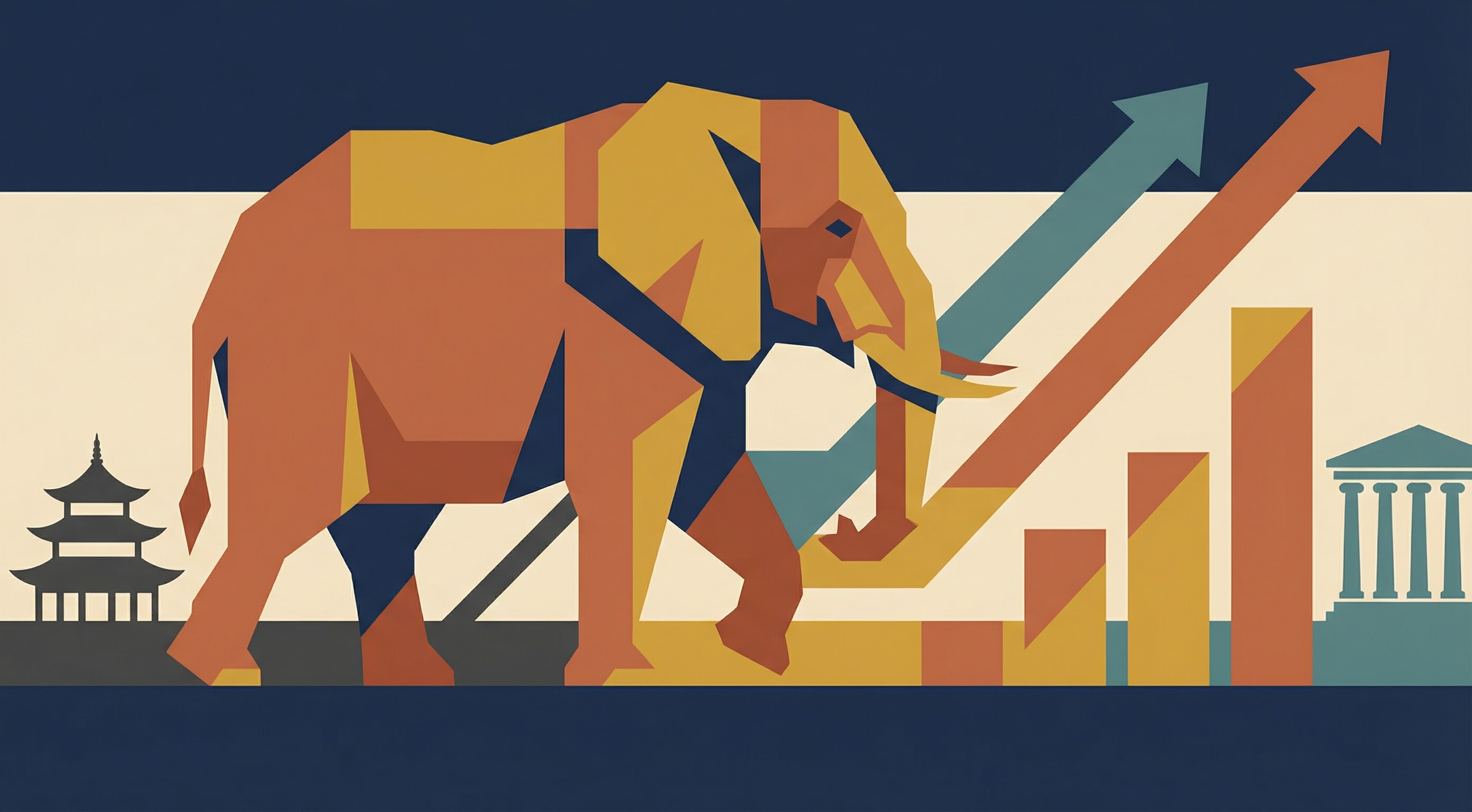
On 23 August 2023, India’s Chandrayaan-3 spacecraft touched down on the lunar south pole — a region no other nation had reached. The mission cost approximately $75 million. For context, the Hollywood film Gravity, which depicted a fictional space disaster, cost $100 million. India reached a place on the Moon that neither America, Russia, nor China had managed to land on, and it did so for less than the price of Sandra Bullock pretending to float in zero gravity.
This is the contradiction that defines India and that the West consistently underestimates. A nation where 200 million people still lack reliable electricity put a spacecraft where nobody else had landed. A country with more people living in poverty than the entire population of Western Europe simultaneously runs the world’s largest biometric identity system, exports more IT services than any other nation, and operates a digital payments infrastructure that processes more real-time transactions than the United States and Europe combined (NPCI, 2024).
The British ruled India for two hundred years and left behind cricket, railways, and the unshakeable assumption that India would always be a rather magnificent mess. Two out of three were right. The third is becoming embarrassingly wrong.
The world has spent the past thirty years fixated on China’s rise. Thousands of books, millions of column inches, and an entire sub-industry of geopolitical commentary have been devoted to the question of what happens when China becomes the largest economy in the world. The question was reasonable. But it may have been the wrong one. The more consequential story — the one that will reshape the global order more profoundly and more durably — is happening next door.
India surpassed China as the world’s most populous country in April 2023 (UN Population Division, 2024). Its economy is growing faster than any other major nation’s. Its median age is twenty-eight. And unlike China, which achieved its rise through one-party authoritarianism, state-directed investment, and the suppression of individual liberties, India is doing it as a chaotic, fractious, exasperating democracy. That distinction matters more than any GDP figure.
The Demographic Dividend
Demographics is destiny. It is the slowest-moving and most powerful force in geopolitics, and it is almost never wrong over the long run. Every great power in history achieved its dominance during a period when its population was young, growing, and urbanising. Britain’s Industrial Revolution coincided with a population explosion — from 6 million in 1750 to 21 million by 1850 (Wrigley, 2016). America’s rise to superpower status was fuelled by wave after wave of young immigrants pouring into a continent with seemingly limitless land and resources. China’s economic miracle from 1980 to 2020 was powered by the largest working-age cohort in human history, a demographic dividend created by the very population growth that Mao had encouraged before the one-child policy curtailed it.
The Age of Nations: Median Age by Country (2025)
A world divided by youth and age — India (orange) sits at the young end while Europe and East Asia grey rapidly
Source: UN Population Division, World Population Prospects 2024
India’s demographic dividend is only just beginning. Its median age in 2025 is 28.4 years — younger than China (39.6), the United States (38.5), the European Union (44.4), Japan (49.1), or South Korea (44.5) (UN Population Division, 2024). India has approximately 600 million people under the age of twenty-five. That is nearly twice the entire population of the United States, and it represents the largest cohort of young people any single country has ever possessed.
Median Age Comparison: The Youth Gap (2025 and 2050)
India is the youngest major economy — and will remain so for decades
Source: UN Population Division, World Population Prospects 2024
China, by contrast, is ageing faster than any major economy in history. Its working-age population peaked in 2015 and has been declining since. The one-child policy, enforced from 1979 to 2015, created an inverted demographic pyramid that no amount of policy reversal can fix. China will grow old before it grows rich — or, more precisely, before most of its citizens grow rich. By 2050, China will have more people over sixty-five than the entire current population of Europe (UN Population Division, 2024).
Japan’s experience is instructive. In 1990, Japan was widely expected to overtake the United States economically. It never did. Its population began ageing, its workforce shrank, and it entered three decades of stagnation from which it has not emerged. Japan’s median age is now forty-nine. Its population has been declining since 2010. It is the world’s most detailed preview of what demographic decline does to economic dynamism, and the preview is not encouraging.
The Demographic Dividend Window: Working-Age Population as Share of Total
India's window opened around 2010 and peaks in the 2040s — the last major dividend on Earth
Source: UN Population Division, World Population Prospects 2024
India has the opposite problem — and the opposite opportunity. Its dependency ratio (the number of non-working-age people per worker) is falling and will not reach its minimum until approximately 2040 (World Bank, 2024). This means India has a fifteen-year window in which its workforce will be at maximum proportion relative to its dependent population. This is the demographic dividend: the period when a nation has the most workers and the fewest dependents, and when economic growth can be extraordinary if the right conditions are in place.
Britain had this window from roughly 1780 to 1850. The United States had it from 1880 to 1960. China had it from 1985 to 2015. India’s window opened around 2010 and will not close until the mid-2040s. It is the last major demographic dividend on Earth.
The Mughal-to-Modi Arc: India’s Cycles of Unity and Fragmentation
India is not a new civilisation pretending to be a country. It is one of the oldest continuous civilisations on Earth, with a political history of recurring cycles of unity and fragmentation that offers both reassurance and warning.
The Maurya Empire under Ashoka (c. 268–232 BC) was the first to unify most of the subcontinent, extending from Afghanistan to Bengal. It was one of the largest empires in the ancient world, governing perhaps 50 million people at a time when the Roman Republic had not yet conquered the Mediterranean (Thapar, 2002). Ashoka’s edicts, carved into rock pillars across the subcontinent, represent perhaps the earliest example of a ruler attempting to govern through moral persuasion rather than brute force alone.
But the Maurya Empire fragmented after Ashoka’s death, as Indian empires tended to do. The Gupta Empire (c. 320–550 AD) — India’s “Golden Age” of science, mathematics, and literature — followed the same pattern: brilliant consolidation, then gradual disintegration. The Mughal Empire (1526–1857) achieved the most extensive unification since Ashoka, at its peak under Aurangzeb governing roughly 150 million people and producing perhaps 25 per cent of global GDP (Maddison, 2007). But Mughal unity too was built on military conquest and administrative genius that could not survive the weakening of the centre.
The British Raj (1858–1947) unified the subcontinent through extraction rather than integration. It built railways, telegraphs, and a civil service — but it did so to move resources from the interior to the ports and thence to Britain. The administrative apparatus was impressive; the purpose was colonial.
Independent India’s achievement, which is consistently underestimated by Western observers, is that it unified the subcontinent through democracy. When India gained independence in 1947, virtually no serious observer expected it to remain a single country, let alone a functioning democracy. The American diplomat George Kennan called it “a mere geographic expression” (Guha, 2007). India had 500 princely states, fourteen major languages, six major religions, thousands of castes, and a population that was 85 per cent illiterate. Every precedent suggested it would fragment, as so many other post-colonial states did.
It did not. India held its first general election in 1951–52, the largest democratic exercise in human history at the time, with 173 million eligible voters. It has held elections continuously since. Power has transferred peacefully between parties dozens of times. The judiciary, for all its delays, operates independently. The press, for all its chaos, is free. This is not a minor accomplishment. It is, in the context of post-colonial history, arguably the most remarkable political achievement of the twentieth century.
The historical parallel is not China but the United States. America in the 1850s was riven by slavery, plagued by corruption, scarred by violence, and dismissed by European sophisticates as a vulgar experiment that would inevitably fail. It was also the most economically dynamic society on Earth. India today has caste, corruption, communal tensions, and grinding bureaucracy. It is also growing faster than any comparable economy. The mess and the dynamism are not contradictions. They are, historically, the same thing.
Why India Is Not China
The comparison between India and China is inevitable, and almost everyone gets it wrong — because they compare the two countries on China’s terms.
China’s growth model was state-directed, export-led, and authoritarian. The Chinese Communist Party mobilised capital, directed it into manufacturing and infrastructure, suppressed wages to maintain export competitiveness, controlled the currency, and built the most extensive system of domestic surveillance in human history to maintain political control. It worked spectacularly well as a catch-up strategy. China went from a GDP per capita of $200 in 1980 to over $12,000 by 2023 (World Bank, 2024). It built more high-speed rail than the rest of the world combined, more skyscrapers than the United States and Europe together, and became the world’s largest manufacturer, exporter, and holder of foreign currency reserves.
But the model has structural limits that are now becoming visible. State-directed investment produced spectacular growth and spectacular waste: ghost cities, bridges to nowhere, a property sector that consumed 30 per cent of GDP and is now deflating painfully (Rogoff and Yang, 2023). The one-child policy solved the immediate problem of feeding a billion people but created a demographic crisis that will define China’s next fifty years. And authoritarian control, which was efficient for building infrastructure, is less efficient for fostering innovation — because innovation requires the freedom to fail, to dissent, and to challenge orthodoxy, none of which authoritarian systems tolerate easily.
GDP Growth Trajectories: India vs. China vs. United States (2000–2050)
India's GDP is projected to surpass Japan and Germany, reaching third place by 2030
Source: World Bank; IMF World Economic Outlook 2024; Goldman Sachs projections (dashed = projected)
India’s growth model is almost the opposite. It is consumption-driven rather than export-led: domestic demand accounts for approximately 60 per cent of GDP (IMF, 2024). It is services-led rather than manufacturing-led: India’s IT services sector alone employs over 5 million people and generates $250 billion in annual revenue (NASSCOM, 2024). And it is chaotic rather than planned — growth happens despite the government, not because of it.
This matters because the historical pattern is clear. Authoritarian catch-up strategies have a ceiling. Imperial Germany industrialised faster than Britain in the late nineteenth century using state-directed industrial policy, but it was Britain’s more open, messier system that proved more adaptable over the long run. The Soviet Union industrialised faster than any country in history between 1930 and 1960, but the model collapsed when the easy gains were exhausted and innovation became the driver. Japan’s state-directed model (MITI and the keiretsu system) produced the economic miracle of the 1960s–1980s, but the same institutional rigidity that enabled rapid catch-up prevented adaptation when the model matured.
India will never grow as fast as China did in the 2000s and 2010s. It will never build infrastructure as quickly, never mobilise capital as efficiently, and never achieve the aesthetic satisfaction of gleaming new cities and bullet trains. But it may not need to. If India can sustain 6–7 per cent growth for two decades — which is well within the range of credible projections (IMF, 2024; World Bank, 2024) — it will be the world’s third-largest economy by 2030 and may challenge the United States for second place by 2050.
The Obstacles: Why India Could Still Fail
It would be dishonest to write about India’s rise without acknowledging the forces that could derail it. They are formidable.
Infrastructure remains woefully inadequate. India’s roads, railways, ports, and airports are improving but still lag far behind China’s. Moving goods from a factory in Tamil Nadu to a port in Gujarat can take longer than shipping them from Shanghai to Rotterdam. The Modi government’s infrastructure spending has been substantial — over $100 billion per year since 2020 — but the backlog is enormous.
Bureaucracy is India’s hereditary disease. The British Raj created a bureaucratic apparatus designed to control, not to enable. Independent India inherited it and added layers. Starting a business in India requires navigating a thicket of permits, licences, and inspections that would have impressed the Mughal revenue administration. The World Bank’s Doing Business rankings (before they were discontinued) consistently placed India in the bottom third globally.
Water is potentially the most serious constraint. India’s groundwater is being pumped at unsustainable rates. The Central Ground Water Board has classified 17 per cent of India’s groundwater assessment units as “over-exploited” (CGWB, 2023). The Ganges basin, which supports 500 million people, faces escalating pollution and seasonal scarcity. Climate change is making monsoon patterns less predictable. A serious water crisis could derail India’s growth more effectively than any geopolitical rival.
Communal tensions between Hindus and Muslims — stoked by political entrepreneurs on both sides — remain a fault line. The Modi government’s Hindu nationalist agenda has raised temperatures. India’s 200 million Muslims are the world’s third-largest Muslim population. Managing this diversity is India’s oldest challenge.
Caste persists as a social barrier despite decades of affirmative action. It constrains labour mobility, educational opportunity, and social capital in ways that are difficult for outsiders to appreciate.
And yet. Every rising power in history faced comparable obstacles. The United States in the 1870s had no national infrastructure, rampant corruption (the Gilded Age makes modern India look tame), racial apartheid in the South, and periodic financial panics that made the 2008 crisis look mild. It became the world’s largest economy by 1890. The obstacles were real. They were not decisive.
The Future: India at Two Billion
The UN’s medium-variant projection places India’s population at approximately 1.7 billion by 2050, peaking around 2065 at roughly 1.75 billion before beginning a slow decline (UN Population Division, 2024). India’s fertility rate is already below replacement level at 2.0 children per woman nationally, and below 1.7 in southern states like Kerala and Tamil Nadu. India will not reach two billion. It does not need to.
What matters is the age structure, not the absolute number. In 2050, India will have approximately 1.05 billion people of working age (15–64), making it the largest workforce on the planet by a wide margin. China will have approximately 840 million working-age people, down from its peak of over 1 billion. The European Union will have roughly 230 million. Japan will have about 55 million. The labour force is the engine of economic output, and India’s engine will be the largest in the world for the rest of the century.
The geopolitical implications are profound. India is already the world’s most important swing state in the emerging bipolar competition between the United States and China. It is a member of the Quad (with the US, Japan, and Australia), but also of BRICS (with China, Russia, Brazil, and South Africa). It buys Russian oil and American weapons. It hosts Google’s largest office outside the United States and Huawei’s largest research centre outside China. It is playing both sides, and both sides need it more than it needs them.
The Indian Ocean, which connects the oil of the Persian Gulf, the manufactures of East Asia, and the raw materials of Africa, is the most strategically important body of water in the twenty-first century. India sits at its centre. The Strait of Malacca, through which 40 per cent of global trade passes, is within range of Indian naval power. The Persian Gulf, from which India imports 85 per cent of its oil, is an Indian strategic interest that no other power can secure on India’s behalf. Geography, like demography, is not a policy choice. It is a constraint and an opportunity, and India’s geography is magnificent.
The question is not whether India will rise. It is rising. The question is whether it will rise fast enough and coherently enough to translate demographic weight into economic power and economic power into geopolitical influence before its own demographic window begins to close in the 2040s. Britain had roughly seventy years (1780–1850) to exploit its demographic and industrial advantages. America had roughly eighty (1880–1960). China had thirty-five (1980–2015), and it may have peaked. India has perhaps twenty-five years remaining — from now until the mid-2040s — to convert its demographic dividend into durable economic and strategic weight.
Twenty-five years is not long. But it is enough. Britain industrialised in less. America became a superpower in less. The question, as always, is not whether the window exists. It is whether the nation has the wit and the will to step through it.
The elephant is awakening. It would be unwise to assume it will go back to sleep.