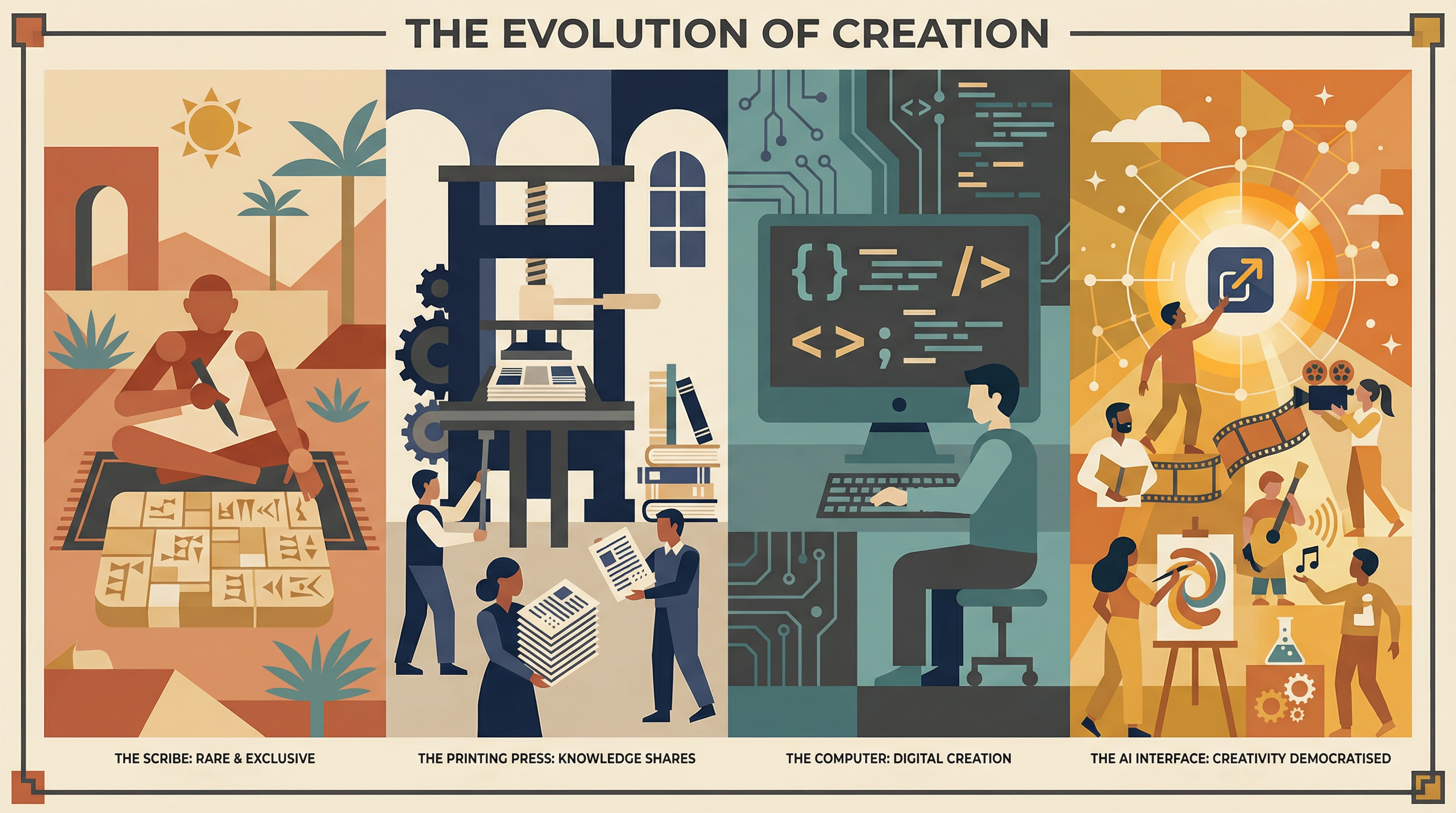
Imagine a merchant in the city of Ur, around 2000 BC. He wants to send a message to a trading partner in Dilmun about a shipment of copper. He cannot write — fewer than one person in a hundred can. So he walks to the scribal quarter and pays a professional scribe to press the message into a wet clay tablet using a reed stylus. When the tablet arrives in Dilmun, the recipient cannot read it either, so he pays another scribe to read it aloud. Two middlemen, two fees, for a single sentence about copper.
Replace “scribe” with “developer” and “clay tablet” with “app,” and you have described the technology industry of 2024. The Sumerian scribe charged two shekels of silver per tablet. A freelance React developer charges rather more per hour — but the dynamic is identical. You have an idea. You cannot manifest it in the medium. You pay someone who can. They may or may not understand what you actually wanted. The lost-in-translation problem is five thousand years old.
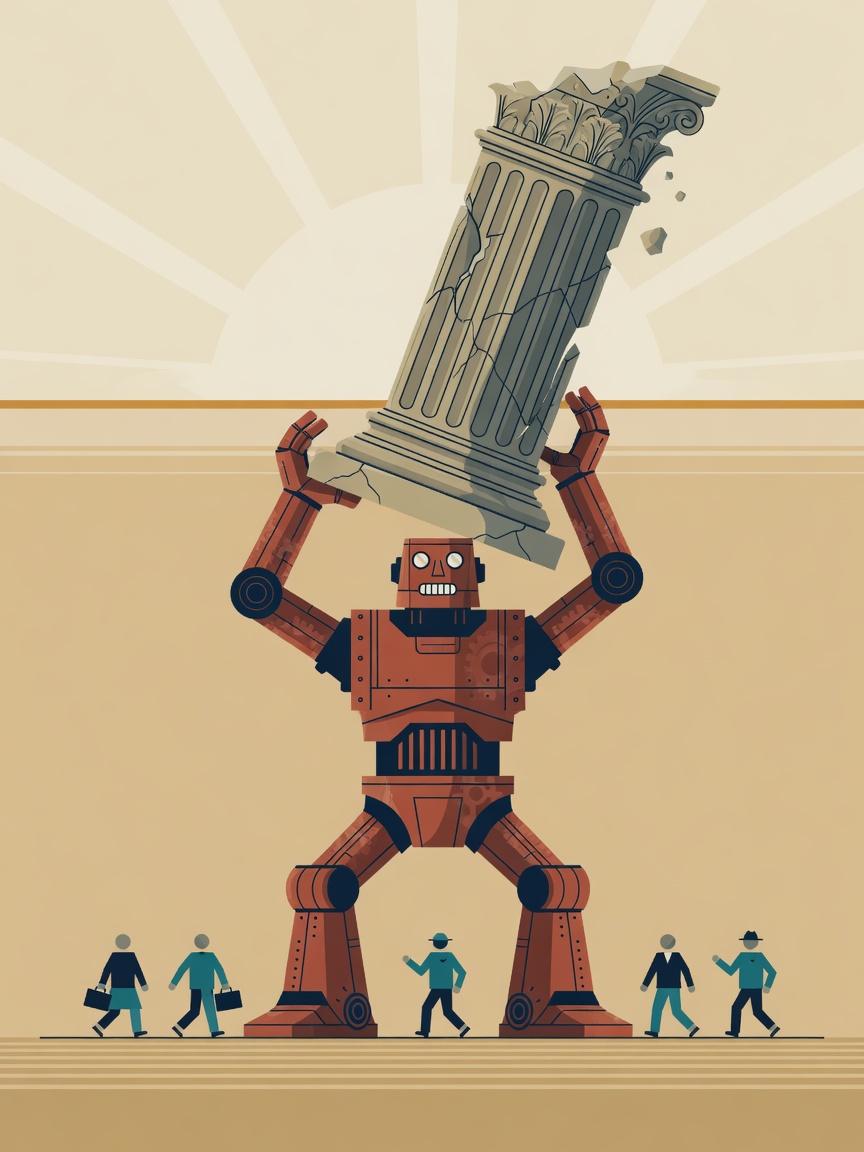
This is an article about what happens when the middlemen disappear. Artificial intelligence is doing to the digital scribal class — developers, designers, filmmakers, marketing strategists — what the printing press did to monastic copyists and what mass literacy did to the scribes of the ancient world. The middlemen are being eliminated. An extraordinary flourishing is beginning. But history also reveals a darker pattern that follows every such liberation: democratisation leads to dependency, and dependency leads to atrophy. The question is not whether the flourishing will happen — it already is — but how long it lasts before we stop doing things ourselves entirely.
The Dependency Curve: Skill Atrophy After Tool Adoption
Every democratised tool follows the same arc: flourishing, then dependency, then atrophy. Each successive technology compresses the cycle faster.
Source: Author synthesis; Carr, The Shallows (2010); National Numeracy (2019); Dahmani & Bohbot (2020)
Five Thousand Years of Middlemen
Writing was invented in Sumer around 3200 BC, and it was not invented for literature. It was invented for accounting — grain stores, tax assessments, livestock tallies, debt records. The earliest written documents are receipts, not epics. Gilgamesh came later. For its first two and a half millennia, writing remained the exclusive property of a tiny caste. Literacy rates in Mesopotamia, Egypt, the Indus Valley, and early China are estimated at well below one per cent of the population — roughly comparable, as it happens, to the proportion of the global population today that can write production-quality software.
Every contract, every law, every religious text, every diplomatic letter, and every tax record passed through the scribes’ hands. In Egypt, the Satire of the Trades, composed around 1900 BC, described every other occupation as miserable — the farmer is exhausted, the soldier is beaten, the fisherman is eaten by crocodiles — while urging the reader: “Be a scribe, for it frees you from toil.” The scribes did not merely record the will of the powerful. They shaped it. If you could not read a contract, you could not verify its terms. If you could not write a law, you could not challenge one. The scribal monopoly was not just economic. It was epistemic — a monopoly on the ability to know.
Global Literacy Rates Over Five Thousand Years
For most of human history, fewer than five per cent of people could read or write. The alphabet, printing press, and compulsory education each triggered step-changes — AI may be triggering the next.
Source: Our World in Data (2023); Harris, Ancient Literacy (1989); Havelock (1982); UNESCO
This dynamic — the individual separated from their own intentions by a specialist intermediary — persisted, in one form or another, for five thousand years. It was not always benign. The medieval Church maintained its authority partly through a monopoly on Latin literacy; the laity could not read the Bible and therefore could not challenge the interpretation of those who could. Colonial administrators used literacy differentials to control subject populations — in the Belgian Congo, educating Africans beyond a basic level was actively discouraged, because literate subjects ask inconvenient questions. Control of the medium has always been control of the message.
The Three Revolutions That Killed the Scribes
The scribal monopoly was broken in three stages, each of which triggered a flourishing so profound that it reshaped civilisation.
The first was the alphabet. Around 1050 BC, the Phoenicians developed a writing system of roughly twenty-two consonantal signs — a radical simplification from the hundreds of cuneiform or hieroglyphic characters that had required years of dedicated memorisation. The Greeks adopted it and added vowels, creating the first fully phonetic alphabet. Within two centuries, Greek literacy rates rose to an estimated ten to fifteen per cent of adult males — a tenfold increase from the ancient Near Eastern baseline. This was the enabling infrastructure of the classical world. Philosophy, drama, history, democratic debate — all depended on a writing system simple enough that a citizen, not merely a priest, could use it. The Athenian Assembly, in which citizens debated policy and voted directly on laws, would have been impossible without the alphabet’s democratisation of the written word.
The second was the printing press. When Gutenberg printed his Bible around 1440, a handwritten book cost roughly the same as a small house. The monastic copyists who produced them worked slowly and expensively — a single manuscript Bible took a scribe approximately three years. Within fifty years of Gutenberg’s innovation, the cost of a printed book had fallen by eighty per cent. The copyists were destroyed as a profession within a generation. What replaced them was everything: the Reformation, fuelled by pamphlets; the Scientific Revolution, enabled by the rapid dissemination of findings; the Enlightenment; the novel; the newspaper; the written constitution. European literacy climbed from roughly five to ten per cent in 1400 to over fifty per cent by 1800 and above ninety-five per cent by 1950. The middlemen lost their livelihoods. Humanity gained its voice.
The third was compulsory education. Prussia introduced mandatory schooling in 1763; Britain followed with the Elementary Education Act of 1870; France with the Ferry Laws of 1881–82. By the early twentieth century, the scribe — the cognitive middleman who had existed in every human civilisation for five thousand years — was comprehensively extinct. Everyone could write. The monopoly was over.
The New Scribes
Except that it was not over. As traditional literacy became universal, a new scribal class formed — this time in silicon rather than clay.
Software was as opaque to the average person as cuneiform had been to the Sumerian merchant. If you wanted a website in 1995, you hired a developer. An app in 2010 required a development team. A brand identity required a designer. A video advertisement required a production company with cameras, editors, and a budget measured in tens of thousands. As of 2024, roughly twenty-eight million people worldwide could write production-quality software — approximately 0.35 per cent of the global population, remarkably close to the scribal proportion in ancient Mesopotamia. The global IT services market reached $1.24 trillion in 2024; creative services added another $600 billion. The fundamental dynamic was identical to Ur: you had an idea, you could not manifest it in the medium, and you paid someone who could. Anyone who has commissioned software development will recognise the ancient merchant’s frustration. The specification is misunderstood. The timeline doubles. The cost triples. The delivered product resembles what you asked for in the way that a police sketch resembles the suspect.
The digital scribal class, like its ancient predecessor, derived its power not from talent alone but from the inaccessibility of the medium. As long as code was hard, coders were essential. As long as design tools required years of training, designers were essential. As long as video production required cameras, lighting rigs, and editing suites costing tens of thousands, production companies were essential. The monopoly depended on the barrier. The barrier was not a conspiracy — software genuinely is difficult, and the people who mastered it genuinely possess remarkable skills. But the economic structure it created was identical to the scribal economy of the ancient world: a tiny literate class mediating between everyone else and the dominant medium of the age.
When the barrier falls, the monopoly follows. Every time. Without exception.
The Printing Press Moment
The Cost of Creating: Specialists vs AI Tools
AI has reduced the cost of digital creation by 80-95 per cent in under two years — a compression comparable to the printing press's impact on book production.
Source: Upwork (2024); Fiverr market data; industry estimates; author analysis
The barrier fell. Not gradually, as optimists predicted. Rapidly, as history suggested it would.
Large language models capable of writing functional code appeared with GitHub Copilot in 2021 and matured through 2023 and 2024 into systems that could produce entire applications from natural language descriptions. GitHub reported that developers using Copilot completed tasks fifty-five per cent faster. But the more consequential finding was that non-developers could now produce functional software. A teacher could describe a classroom management tool in plain English and receive a working prototype within hours. A small business owner could produce a customer portal, a booking system, or a marketing video without hiring an agency or learning a programming language.
By early 2026, agentic AI systems — models that could plan, execute, and iterate on multi-step tasks autonomously — had pushed the frontier further. These systems did not merely write code; they orchestrated entire workflows: research, design, implementation, testing, deployment. The scribal monopoly depended on the medium being inaccessible. When the medium becomes accessible to anyone who can describe what they want, the monopoly collapses. The scribes are watching the printing press being assembled, and they can see exactly where this is going.
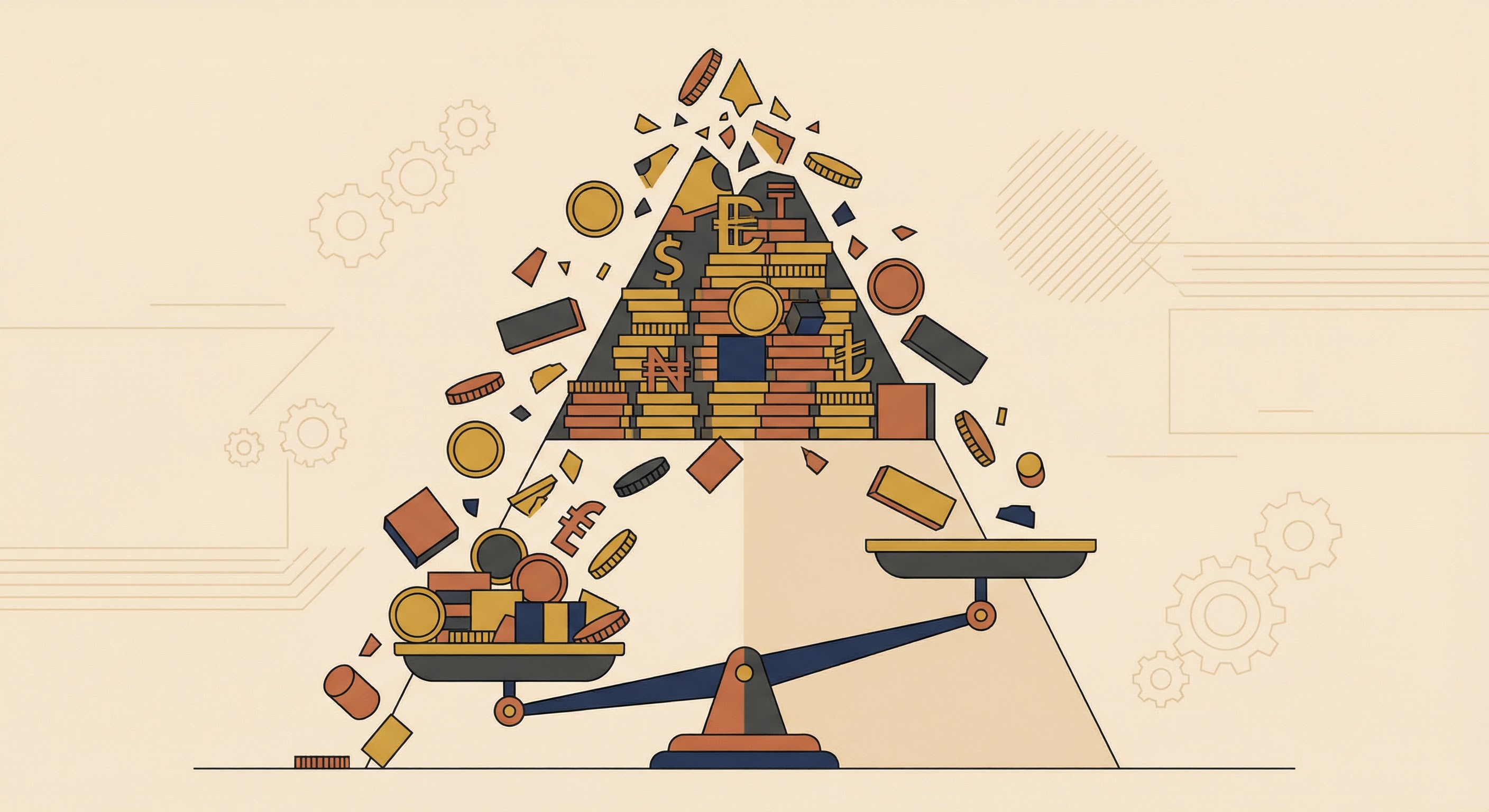
The Scribal Economy Under Threat
Over $3 trillion in global "scribal" services — specialist intermediaries between people and digital creation — face AI-driven disintermediation.
Source: Statista (2025); McKinsey Global Institute (2023); Goldman Sachs (2023)
The Flourishing — and What Comes After
History is clear about what happens next: a flourishing. When the printing press made text production cheap, entirely new forms emerged — the novel, the newspaper, the scientific journal, the written constitution. When mass literacy gave everyone access to the written word, the volume and variety of written expression exploded beyond anything the medieval world could have conceived. The AI-enabled flourishing is already visible: micro-SaaS products for niche markets that no traditional company would serve; a creator explosion in film, animation, music, and games; small businesses producing marketing materials, client portals, and data tools that previously required agencies charging six-figure fees.
This is the golden moment — the brief, exhilarating interval between liberation and dependency. Enjoy it while it lasts.
Because history also says it does not last. Every democratisation of a cognitive tool follows a four-phase pattern: democratisation, flourishing, convenience dependency, skill atrophy. Consider writing itself: mass literacy produced novels and newspapers, but by the late twentieth century most people used writing for shopping lists and text messages. The capacity for sustained argumentative prose atrophied. Calculators enhanced mathematical capability; within a generation, most people could not perform mental arithmetic that their grandparents did routinely. GPS initially empowered navigation; research published in Nature Communications in 2020 found measurable atrophy in spatial cognition among heavy GPS users. Spell-check correlates with declining spelling accuracy when the tool is unavailable. Nicholas Carr documented this pattern across multiple cognitive domains in The Shallows.
Applied to AI, the phases look like this. Phase 1 — people use AI to do things they could not do before. Pure gain. This is where we are now. Phase 2 — people use AI for things they could do, but AI does them faster and cheaper. The underlying skills erode through disuse. Phase 3 — people cannot do things without AI because they never learned or have forgotten. The tool becomes a prosthetic; removing it reveals the atrophied limb beneath.
The flourishing typically spans one to two generations before dependency dominates. Each successive technology has compressed the cycle. If calculators took thirty years and GPS took ten, AI — which can do nearly everything the human can do, and is improving monthly — might compress it to five.
The optimistic case is that AI is different because it is general, not specific. The teacher building a classroom app is not passively consuming — she is describing, iterating, refining, making judgement calls about what works. The interaction requires vision and taste, which may deepen with use rather than atrophy. The pessimistic case is that when AI can produce an adequate film from a one-sentence prompt, very few people will bother to learn filmmaking. The gap between “adequate” and “exceptional” is precisely where human skill, judgement, and taste live — and it is a gap that most people, for most purposes, will not bother to cross. The Sumerian merchant did not need to write brilliantly. He needed to communicate about copper. If AI provides the adequate result — good enough for the purpose, available instantly, at negligible cost — the incentive to develop deeper capability evaporates. The merchant never learned to write. He did not need to. That was the scribe’s job. When the scribe is an algorithm, the dynamic is the same: the human capacity atrophies because the tool makes it unnecessary.
Who Can Code? The New Literacy Curve
Traditional developers number roughly 30 million. AI-assisted creators — people producing functional software with AI tools — are growing exponentially and may outnumber developers 10:1 by 2030.
Source: Evans Data Corporation (2024); GitHub; Stack Overflow Developer Survey; Gartner low-code forecasts
The most troubling historical parallel may be the automobile. Mass car ownership gave everyone the ability to travel freely. It also destroyed the physical fitness that walking and cycling had maintained as a byproduct of daily life. The convenience was real. The atrophy was also real. Both happened simultaneously, and the atrophy was noticed only decades later, when its health consequences had become entrenched.
Literacy and Literature
The digital scribes — developers, designers, agencies, the entire $1.8 trillion intermediary economy — are the scribes of our age. Their monopoly is ending. The flourishing has begun. But when everyone could write, most people stopped thinking carefully about words. When everyone could calculate, most people stopped thinking carefully about numbers. When everyone could navigate by satellite, most people stopped knowing where north was.
The distinction that will matter is between literacy and literature. Mass literacy gave everyone the ability to write; it did not make everyone a writer. Mass car ownership gave everyone the ability to travel; it did not make everyone an explorer. The question for AI is whether it produces a civilisation of creators — people who use these tools to build things of genuine meaning and craft — or a civilisation of consumers — people who prompt, accept, and scroll.
The scribes are dying. Long live the scribes. Send that to someone who still thinks AI is just a better spell-check.