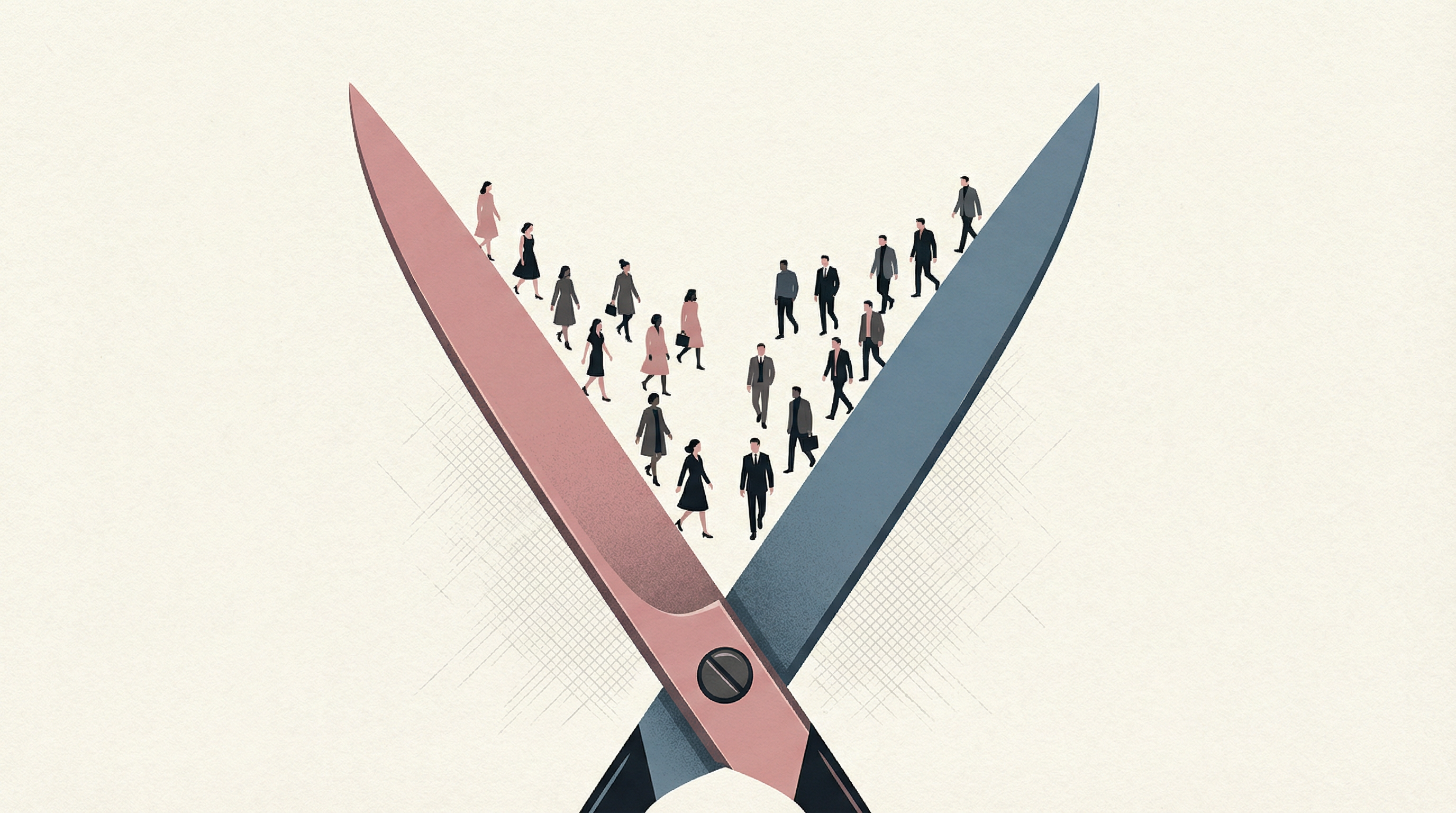
A companion article published on this site — The Great Divergence: Why Young Men and Women No Longer See the Same World — laid out the statistics. A fifteen-point gap in the United States. Twenty-five in Britain. Thirty in Germany. As large as fifty points in South Korea on some measures. Young women in every developed country have moved dramatically to the left. Young men have stayed where they were, or drifted right.
But here is the fact that should stop every analyst in their tracks: the gap does not exist in the Middle East and North Africa. It does not exist in India. It does not exist in Indonesia. And it does not exist in Sub-Saharan Africa — a region where women have the highest labour-force participation rates on the planet, with several countries exceeding eighty per cent.
That last point demands emphasis. If the gender ideology split were simply a product of women entering the workforce, Sub-Saharan Africa should show the widest gaps on Earth. It does not. The Afrobarometer, surveying thirty-nine countries, finds that African men and women hold “relatively similar preferences regarding political and economic regimes.” Whatever is driving the scissors open, it is more specific than women working. It is specific to countries that share a particular history — a history that most of the world does not share.
The Nordic Paradox: Gender Equality vs. Gender Ideology Gap
More gender-equal countries show wider ideological gaps — equality unmasks divergence rather than closing it
Source: Source: World Economic Forum Gender Gap Index (2024); FT/Burn-Murdoch (2024); Lahtinen (2023)
Understanding what that history is, and what it produced, is the key to understanding causation rather than correlation.
What follows is an attempt to identify that causal chain. Nine hypotheses, organised by the depth of the structural force they describe, growing from a seedbed that is unique to a handful of countries. Each hypothesis is tested against three independent falsification tools: the Nordic Paradox from the top of the development spectrum, the developing-world evidence from across five continents, and the demographic shock of war itself.
The Reframing
The Scissors: Liberal Identification Among 18–29 Year Olds (1999–2024)
Women moved sharply left while men stayed remarkably stable — the divergence is asymmetric
Source: Source: Gallup Political Ideology surveys (1999–2024); PRRI (2024)
Before the hypotheses, a correction. The standard framing — “men and women are moving apart” — implies symmetry. The movement is not symmetric.
Gallup’s ideology tracking, running continuously since 1999, shows that young men’s ideological self-identification has been remarkably stable for twenty-five years. In 2000, roughly a quarter of American men aged eighteen to twenty-nine identified as liberal. In 2024, roughly the same proportion did. The change is within the margin of error. PRRI data tells a different story on party identification — young men’s Democratic affiliation dropped sharply between 2020 and 2024 — but this is a party shift, not necessarily an ideological one. Men may be changing teams without changing beliefs.
Women are a different matter. In 2000, thirty per cent of young American women identified as liberal. By 2024, forty per cent did — a tripling of the gender gap. The shift accelerated after 2014, spiked in 2017, and has not reversed.
The more precise question, then, is two questions: “why are women moving left so rapidly?” and “why are men changing party affiliation without changing ideology?” These are different phenomena with different causes, and conflating them produces confused analysis.
Three Tests
Every hypothesis that follows must survive three independent falsification tools.
Test one: the Nordic Paradox. The political scientist Hanna Lahtinen documented that the gender gap in political attitudes is wider in the most gender-equal societies on Earth — Sweden, Finland, Denmark — than in less egalitarian ones. Any hypothesis that frames the gap as a product of inequality is directly falsified by the Nordic data. The gap is a feature of equality, not a legacy of inequality.
Test two: the developing-world control group. The Arab Barometer Wave VIII survey (2024), covering over fifteen thousand interviews across eight MENA countries, found that support for patriarchal norms has increased since 2021 — the opposite of the Western trend. In India, the CSDS-Lokniti post-election survey (2024) found no meaningful gender ideology gap — the BJP is supported almost equally by young men and young women. In Indonesia, the Equimundo study on masculinities (2025) found no Western-style ideology split. And across thirty-nine Sub-Saharan African countries, the Afrobarometer finds no ideological divergence between men and women — despite female workforce participation averaging over sixty per cent.
Test three: the war test. The countries showing the widest gender ideology gaps — Britain, France, Germany, South Korea, Japan — share something that the countries showing no gap do not: the experience of total war in the twentieth century, with mass male casualties and the forced mobilisation of women into the industrial workforce. Any hypothesis that claims to explain the gender split must account for this geographic concentration.
A cause that is supposedly universal but produces effects only in countries that experienced total war is not a cause. It is a correlation wearing a lab coat.
The Seedbed: Demographic Shock
The War Test: Demographic Shock and the Gender Ideology Gap
Countries that experienced mass male casualties in the twentieth century show the widest gender ideology gaps today — countries that did not show no gap, regardless of development level
Source: Source: War casualty data from national records and Britannica; gender gap data from FT/Burn-Murdoch (2024), Arab Barometer (2024), Afrobarometer (2024)
Before the nine hypotheses, the soil they grew in.
Western Europe
The Western world experienced something between 1914 and 1945 that most of the planet did not: the industrialised killing of an entire generation of young men, twice in thirty years.
The First World War killed approximately ten million soldiers, overwhelmingly young men from Britain, France, Germany, Austria-Hungary, Russia, and the Ottoman Empire’s European territories. The Second World War killed approximately twenty million more military personnel, plus tens of millions of civilians. The countries now showing the widest gender ideology gaps — Britain, France, Germany, the Nordic states, the Anglosphere — are the countries that lost the most men.
The consequences cascaded across four dimensions. First, women entered the workforce not as a feminist project but as wartime necessity — British munitionettes, American Rosie the Riveters, Soviet factory workers, German Trümmerfrauen who rebuilt cities from rubble. Between 1914 and 1945, women in combatant nations accumulated thirty years of lived experience in roles that had been exclusively male.
Second, the wars created millions of women who could not marry. After the First World War alone, Britain had approximately 1.7 million “surplus women” — women for whom there were simply no surviving men of marriageable age. France lost 1.4 million men. Germany lost two million. An entire generation of women was forced into permanent economic self-sufficiency not by ideology but by arithmetic.
Third, the welfare state was built partly to support this population. The Beveridge Report of 1942, the NHS of 1948, and their continental European equivalents were designed for a society that included millions of women without male providers. Women’s relationship to the state shifted from indirect — mediated through husbands — to direct, as citizens with their own claims on public resources.
Fourth, and most consequentially, the expectation of female economic participation was transmitted across generations. The war generation raised daughters who knew women could work. Those daughters raised the Baby Boomers. By the time Claudia Goldin’s contraceptive revolution arrived in the 1960s, it was landing on soil that had been prepared for fifty years.
South Korea
The Korean War (1950–1953) killed approximately three million people — roughly ten per cent of the combined Korean population. The demographic shock was proportionally comparable to what France experienced in the First World War. Women were mobilised into post-war reconstruction and industrial development as South Korea transformed from one of the world’s poorest nations into an OECD economy within a generation.
Today, South Korea has the widest gender ideology gap on Earth — as large as fifty points on some measures — and a fertility rate of 0.72 (2023), the lowest ever recorded in any country. The pattern matches the Western trajectory but at extreme velocity: total war, female mobilisation, industrial modernisation, education inversion, and then a gender split so severe that a significant number of young women have adopted the “4B” movement — no dating, no sex, no marriage, no children.
Japan
Japan lost approximately three million people in the Second World War. Women were mobilised into industrial production during the war and into reconstruction afterward. Japan today shows an eighteen-point gender ideology gap (Tokyo Foundation, 2024) — smaller than South Korea’s but clearly present, and notable given Japan’s culturally conservative baseline.
Japan’s trajectory has been moderated by two factors: the hikikomori phenomenon (social withdrawal, disproportionately male) absorbed some male status anxiety into personal retreat rather than political mobilisation, and three decades of economic stagnation dampened the kind of rapid social change that drives polarisation. The gap exists, but it expresses itself differently.
China
China experienced staggering losses — an estimated fifteen to twenty million dead in the Second Sino-Japanese War and subsequent civil war. Mao Zedong’s dictum that “women hold up half the sky” imposed female workforce participation by ideological decree. China today has one of the highest female labour-force participation rates in the world, exceeding sixty per cent.
Yet China does not show a Western-style gender ideology gap. Why? Because the mechanism that opened the scissors in the West was not just women working — it was women working in a democratic society with a welfare state, contraceptive access, educational freedom, and the political space to express divergent views. Mao’s China gave women economic roles without giving them political autonomy or reproductive choice. The workforce participation was imposed, not chosen, and the institutional stack that converts economic independence into ideological divergence was never built.
Rwanda
Rwanda provides the most revealing test of the war-shock hypothesis outside the Western world.
The 1994 genocide killed between 800,000 and one million people in approximately one hundred days — overwhelmingly Tutsi men. In the aftermath, women constituted the majority of the surviving adult population. They entered the workforce not by choice but by demographic necessity, in a pattern structurally identical to post-World War One Europe.
The result: Rwanda became the first country in history to have a female-majority parliament, with women securing fifty-six per cent of seats in the 2008 elections. The government enacted progressive legislation on domestic violence and sexual assault. Women led the country’s reconstruction and reconciliation process.
Rwanda is the proof that the war-shock mechanism is not culturally Western. It is structural. When a society loses a critical mass of its male population, women fill the gap. When women fill the gap, institutions adapt. When institutions adapt, intergenerational expectations change. The mechanism operates wherever the preconditions are met — regardless of continent, religion, or cultural tradition.
But Rwanda also reveals the limits of war shock alone. Rwanda’s gender empowerment operates on a different axis from the Western ideology split. It is about political representation and legal rights, not about the broad left-right ideological divergence seen in the West. Rwanda lacks the other elements of the causal stack — mass contraceptive access, a full education inversion, algorithmic social media, a mature welfare state — that convert female empowerment into ideological polarisation. The seedbed is there. The full crop has not yet grown.
Latin America: The Absent War
Latin America largely avoided the twentieth century’s total wars, making it a natural control group for the war-shock hypothesis.
The results split along a revealing gradient. Argentina and Uruguay, whose populations are approximately eighty-five per cent of European descent, show emerging Western-style gender splits. In Argentina’s 2023 presidential election, Javier Milei drew sixty-eight per cent of men aged sixteen to thirty but only forty-nine per cent of women in the same age group — a nineteen-point gender gap that mirrors Western patterns. These are societies built by European immigrants, many of whom were refugees from or shaped by the world wars. The cultural memory of female economic participation — the intergenerational expectation — travelled with the diaspora.
Bolivia, Peru, and Ecuador, with majority indigenous populations and limited European cultural transmission, show no comparable pattern. Gender politics exists in these countries, but it operates on different axes — indigenous rights, land reform, resource extraction — not the left-right ideological divergence that characterises the Western gender split.
The Latin American gradient does not map onto GDP, education levels, or social media penetration. It maps onto European cultural transmission. This is the war-shock hypothesis expressed not through direct demographic loss but through the intergenerational inheritance of the expectations that demographic loss created.
Tier 1: The Foundations
These are the slow-moving structural forces that created the conditions for divergence over decades. They explain direction and magnitude, though not timing.
Hypothesis 1: The Contraception Long Arc
Claudia Goldin, who received the Nobel Prize in Economics in 2023, demonstrated that the approval of the combined oral contraceptive pill in 1960 fundamentally altered women’s economic horizons. Before the pill, women could not reliably invest in long professional education because pregnancy could derail any career plan. After the pill, they could. For the first time in history, women could plan a professional life with the same time horizon as men.
The downstream chain: contraception enabled career investment, which enabled economic independence, which enabled later marriage, which weakened social interdependence with men, which reduced the need to compromise on political values, which allowed underlying value differences to be expressed.
Developing-world test: MENA countries have significantly lower contraceptive prevalence. India’s total fertility rate remains 2.0. Contraceptive access across Sub-Saharan Africa remains limited. The revolution is incomplete in these regions, and the gender ideology split is absent. Supported.
Nordic test: The pill was adopted earliest and most completely in Scandinavia — and the gap is widest there. Supported.
Hypothesis 2: The Education Inversion
The Education Engine: Women's Degree Attainment and the Ideology Gap
As the education gap widened, the ideology gap followed — education explains roughly half the divergence
Source: Source: OECD Education at a Glance (2024); Gallup; EdWorkingPapers (2025)
Women now earn approximately sixty per cent of all bachelor’s degrees in the United States. In the European Union, forty-nine per cent of women aged twenty-five to thirty-four hold tertiary degrees versus thirty-eight per cent of men — a gap that was zero in 1990. In Canada, seventy-six per cent of young women hold degrees versus fifty-eight per cent of young men.
College attendance has a causal effect on political liberalisation. A 2023 propensity-score-weighted study found that attending college shifts political orientation leftward independent of pre-existing characteristics (Stolzenberg and Reardon, 2023). The effect is strongest in the humanities and social sciences — fields that have skewed heavily female. An EdWorkingPapers analysis (2025) estimated that educational differences explain approximately fifty per cent of the gender gap in voting behaviour.
Developing-world test: In MENA, much of South Asia, and across thirty-nine African countries surveyed by Afrobarometer, women still lag men in secondary and post-secondary education — fifty-one per cent versus fifty-nine per cent in the African data. Where women are not out-educating men, the ideology gap does not appear. Supported.
Nordic test: The education inversion is most advanced in the Nordics — and the gap is widest. Supported.
Hypothesis 3: Economic Displacement and Status Loss
American manufacturing employment peaked at 19.6 million in 1979 and fell to 11.5 million by 2010. Real wages for men without college degrees declined significantly over the same period. Labour-force participation for men with only a high school education fell sharply.
Noah Zucker’s research on “breadwinner backlash” identifies the mechanism: when men lose their economic role as primary earner, they shift toward political movements that promise to restore traditional hierarchies. The MIT team (Autor, Dorn, Hanson) documented the downstream chain: economic decline leads to reduced male marriageability, family breakdown, social isolation, and increased susceptibility to populist messaging.
Developing-world test: In MENA countries, economic crisis is severe — but it pushes both genders toward more traditional norms, not apart. The Arab Barometer data shows convergence during crisis, not divergence. Morocco and Tunisia saw regression toward patriarchal norms linked directly to economic hardship, drought, and COVID-19 impacts. Male economic displacement alone produces retrenchment, not a gender split. It requires the other structural preconditions — female economic independence, education inversion, welfare-state infrastructure — to produce divergence. Refined: necessary but not sufficient.
Tier 2: The Amplifiers
These forces did not create the divergence. They accelerated it, beginning around 2012–2015, when smartphone adoption among teenagers reached critical mass. Critically, they also synchronised it — carrying ideas between culturally similar societies at a speed that made the scissors appear to open simultaneously across the entire West.
Hypothesis 4: Algorithmic Divergence
The Algorithm Machine: How TikTok Sorts Content by Gender
Male-presenting accounts saw misogynistic content rise from 13% to 56% of recommendations in just five days
Source: Source: UCL/Dublin City University quasi-experimental study (2024)
Researchers at University College London and Dublin City University (2024) created TikTok accounts simulating teenage boys. Within five days, misogynistic content rose from thirteen per cent to fifty-six per cent of recommendations. The algorithm did not require the user to seek extreme content. It delivered it as a byproduct of engagement optimisation.
A Princeton study documented the pipeline across thirty thousand YouTube videos: anti-SJW commentary leads to manosphere content, which leads to far-right material.
Developing-world test: Indonesia has very high social media penetration but shows no gender ideology gap. Social media penetration is rising rapidly across Sub-Saharan Africa, yet no ideology gap is emerging. These are the most damaging data points for the algorithmic hypothesis as a standalone explanation. The algorithms can only amplify what the structural preconditions have already created. Without the seedbed of war, contraception, education inversion, and welfare-state independence, the same algorithms produce different outcomes. Weakened as standalone; confirmed as amplifier only.
Nordic test: Norway has similar social media penetration to other Nordics but shows a smaller gender gap, suggesting cultural and institutional variation matters even within the algorithmic environment. Confirmed as insufficient alone.
Hypothesis 5: The Influencer Pipeline
Jordan Peterson’s 12 Rules for Life sold over five million copies, predominantly to young men, and explicitly frames progressive politics as an attack on masculine identity. Andrew Tate accumulated 11.6 billion TikTok views before his arrest. A Sage Journals analysis (2024) of 150,000 words of Tate’s content found systematic “ideological scaffolding” — self-help layered with anti-feminist politics.
The pathway: economic anxiety leads to self-improvement content, which leads to masculinity content, which leads to the manosphere, which leads to right-wing politics. The influencer pipeline explains how economic grievance converts to coherent political identity.
Developing-world test: Peterson and Tate content circulates globally, including in MENA and South Asia. Yet these countries show no comparable male rightward shift on gender issues — because the female leftward movement that creates the perceived threat does not exist there. The pipeline requires a target. Supported as conversion mechanism, not root cause.
The Contagion Channel
The amplifiers do not operate within national borders. They operate across them — and they travel fastest between countries that share language, media ecosystems, and cultural proximity. Research on the diffusion of democratic norms (Cambridge, 2022) found that nations with shared linguistic and religious ancestry develop more similar political trajectories, even after controlling for geography. Ideas spread along cultural lines.
This explains a pattern the structural hypotheses alone cannot: the synchronisation of the scissors across the West. The United States, Britain, Canada, and Australia opened the scissors at almost the same moment — not because they independently developed identical structural conditions on identical timelines, but because they share an English-language media ecosystem that propagates ideas in hours. MeToo went from a Hollywood hashtag to a global movement across eighty-five countries within days, generating twelve million uses on its first day alone. The 4B movement travelled from South Korean feminist forums to American TikTok within weeks of the 2024 election — a non-Western idea resonating instantly in a structurally similar Western society.
The contagion also flows in the other direction. Tate’s content reaches Indian teenagers, Kenyan men, Nigerian youth. In India, children as young as twelve are adopting manosphere language. In Kenya, women’s rights organisations report men in previously stable relationships becoming hostile after consuming masculinity-influencer content, with manosphere mentions averaging over four thousand per day on X in 2023. The ideas land. Individual behaviour changes. But no systemic gender ideology split emerges — because the structural preconditions that convert individual radicalisation into political divergence are absent.
This is the distinction the contagion evidence forces: ideas travel globally, but their systemic impact is gated by structural conditions in the receiving society. The spark reaches everywhere. It only starts a fire where the tinder is dry.
Tier 3: The Crystallisation
Hypothesis 6: Asymmetric Political Mobilisation
The Women’s March of January 2017 was the largest single-day protest in American history. MeToo significantly increased political engagement among women who had experienced harassment. The Dobbs decision (2022) made abortion the number-one issue for young women, outranking inflation and jobs. Post-Dobbs, Democrats gained in virtually every election where reproductive rights were on the ballot.
Men experienced no equivalent leftward mobilising event. Their reaction to these events — perceiving them as anti-male — pushed them right.
Developing-world test: Iran’s Woman Life Freedom movement (2022–present) provides a striking parallel. The GAMAAN survey (2024, over 77,000 respondents) shows seventy per cent oppose the Islamic Republic, with women showing stronger preferences for secular republicanism. Like Dobbs, the trigger was bodily autonomy — compulsory hijab and morality police. When states directly threaten women’s physical freedom, women mobilise regardless of development level. But Iran’s gender split is about regime type, not left-right ideology. Confirmed for bodily-autonomy triggers; culturally specific for broader ideological mobilisation.
Tier 4: The Feedback Loops
Hypothesis 7: The Collapse of Cross-Gender Relationships
Marriage historically moderated political views through cross-gender negotiation. That mechanism is failing. Two-thirds of American singles now reject partners with different politics. Fewer than forty per cent of unmarried women view dating apps as safe.
The feedback loop: political divergence makes relationships harder to form. Fewer relationships mean less moderating contact. Less contact deepens the divergence. No country that has entered this cycle has yet found the exit.
Hypothesis 8: Zero-Sum Framing and the Backlash Loop
Forty per cent of men under fifty who supported Trump agreed that women’s gains came at men’s expense. Young men are twice as likely as men over sixty-five to believe women “have it easier” — a learned, generational belief. Terms like “male privilege” and “toxic masculinity” frame male identity as a problem to be solved rather than a constituency to be persuaded. For men who do not feel privileged, the message is alienating. Alienated constituencies do not reform. They defect.
The Ipsos Equalities Index (2025) found that fifty-one per cent of respondents across thirty countries perceive tension between men and women — fifty-nine per cent among Gen Z, versus forty per cent among Boomers. The youngest generation feels the tension most acutely because they are living inside the ratchet.
Tier 5: The Deep Structure
Hypothesis 9: The Moral Foundations Asymmetry
Jonathan Haidt’s Moral Foundations Theory shows that women weight Care/Harm and Fairness more heavily, while men weight Loyalty, Authority, and Sanctity more heavily. Modern progressive politics operates primarily on Care and Fairness — structurally more resonant with women. Modern conservative politics operates on Loyalty, Authority, and Sanctity — structurally more resonant with men.
For most of history, this predisposition was suppressed by economic interdependence. A woman whose survival depended on her husband could not afford to vote against his interests. As economic independence removed the constraint, the underlying moral divergence was free to express itself.
This is the hypothesis most powerfully confirmed by the global evidence, and the one the Africa paradox illuminates most brightly.
The Control Group
The Control Group: Gender Ideology Gap vs. Female Economic Independence
The scissors only open where women are economically independent in modern economies — Africa has the highest female workforce participation on Earth but no gap, because subsistence agriculture is not economic independence
Source: Source: FT/Burn-Murdoch (2024); World Bank (2024); Arab Barometer (2024); Afrobarometer (2024); CSDS-Lokniti (2024); Ipsos (2025)
The developing-world evidence deserves its own section because it does something no single Western dataset can: it tests whether the gender ideology split is a feature of modernity itself or a feature of a specific kind of modernity — one shaped by total war, welfare states, contraceptive revolutions, and education inversions.
Sub-Saharan Africa: The Paradox That Refines the Theory
Sub-Saharan Africa has the highest female labour-force participation rate of any world region — averaging over sixty per cent, with Madagascar at eighty-three per cent, Burundi at seventy-nine, Mozambique at seventy-eight, and Tanzania at seventy-seven. If the gender ideology split were simply a product of women working, Africa should show the widest gaps on the planet.
It does not. The Afrobarometer, surveying thirty-nine countries, finds that men and women hold similar political and economic preferences. Women are more likely to express ambivalence and are less politically active than men — but there is no ideological divergence of the kind seen in the West.
Why? Because subsistence agriculture is not economic independence. A woman farming a smallholding is not equivalent to a woman earning a salary in a service economy with state healthcare, a pension, and child support. The mechanism that opens the scissors requires not just women working, but women working in modern economies with institutional infrastructure that enables independence from individual men. The welfare state — the institution built in the West to support millions of post-war surplus women — has no equivalent across most of Sub-Saharan Africa.
The education data confirms this. Across Afrobarometer’s thirty-nine countries, women lag men in secondary and post-secondary education: fifty-one per cent versus fifty-nine per cent. The education inversion that is central to the Western gender split has not occurred.
Rwanda stands alone as the exception — and the exception proves the rule. The one African country that experienced a demographic shock comparable to the World Wars is the one African country that shows dramatically elevated female political empowerment. The mechanism is structural, not cultural.
The African liberation wars — Kenya’s Mau Mau rebellion, Algeria’s war of independence, the anti-apartheid struggle in South Africa — mobilised women extensively. But the post-independence governments did not build welfare states for surplus women. Research on Kenya and Zimbabwe finds that nationalist parties “incorporated ideologies that regenerated traditional culture” rather than creating the institutional infrastructure for female economic independence. The war alone is not enough. The institutional response to the war — the welfare state, the education investment, the contraceptive provision — is what creates the long-term divergence.
The MENA Mechanism: Causation Caught in the Act
The Middle East and North Africa experienced none of the Western sequence. The wars did not happen in the way that mobilised women into the industrial workforce. The welfare state was not built for surplus women. The education inversion has not occurred.
And the gap does not exist. The Arab Barometer (2024) documents women moving toward more patriarchal norms — the opposite of the Western trajectory. Women’s support for male political leadership rose by thirteen points in Kuwait, twelve in Tunisia, ten in Jordan and Morocco between 2021 and 2024. Economic crisis is the driver: when economies collapse, both genders retrench toward traditional breadwinner models.
But MENA provides something even more valuable than the absence of a gap. It provides the mechanism made visible.
The Arab Barometer’s most striking finding is this: having female relatives who held a job is the single strongest predictor of gender-equality attitudes — for both men and women. Men with working female relatives hold opinions significantly closer to women’s views than men without. Women with working female relatives show even stronger pro-equality beliefs than women who worked themselves.
This is the causal link caught in the act. It is not abstract ideology that changes attitudes. It is the lived experience of seeing women work — not in subsistence farming, but in paid employment outside the home. Kuwait, where government-funded public-sector employment has created high female participation, shows the most progressive attitudes in the region. Mauritania, where very few women have ever held a job, shows the most traditional. The gradient within MENA alone maps precisely onto female workforce participation in the modern economy.
The MENA evidence confirms the African paradox from a different angle: it is not women working per se that drives the split. It is women working in modern economies, in ways that are visible to their families, that changes how everyone thinks about gender.
India: Welfare Without Independence
India is the most revealing single case for understanding why the split is absent.
India has high social media penetration, a large young population, rising educational attainment, and a politically active democracy. Yet the CSDS-Lokniti post-election survey (2024) found the BJP drawing thirty-seven per cent of men and thirty-six per cent of women — a one-point gap. The Ipsos 2025 survey found Indians “among the world’s most progressive on gender equality,” with seventy-seven per cent of men and eighty per cent of women agreeing it is personally important. The three-point gap is negligible by Western standards.
Why? Because India’s female labour-force participation rate remains below thirty per cent by international measures — among the lowest in the world for a major economy. The Economist (2024) calls it “the mystery of India’s female labour-force participation rate”: even as GDP rises, women are not entering the formal workforce at rates seen elsewhere. Cultural factors, safety concerns, and inadequate childcare keep the participation rate low despite economic growth and rising education. Meanwhile, the manosphere has arrived: Indian teenagers are adopting Tate’s language, masculinity influencers command millions of followers, and boys as young as twelve use terms like “beta male” in school. The ideological content has crossed the border. The systemic split has not followed — because the structural preconditions to convert individual attitude change into political divergence are missing.
India also reveals an alternative model of the state-to-women relationship. The BJP under Modi has dramatically increased its support among women through targeted welfare transfers — the Ujjwala scheme providing cooking gas connections, the Ladki Bahin scheme providing monthly cash payments to low-income women. These programmes create a direct relationship between women and the state — superficially similar to the Western welfare state — but they reinforce traditional gender roles rather than enabling independence. Women vote for the party that provides domestic assistance, not the party that represents a distinct ideological worldview. The welfare state that opens the scissors is one that enables women to live independently of men. India’s welfare transfers make domestic life more comfortable without altering the structural dependency.
Indonesia: The Algorithm’s Null Result
Indonesia delivers the single most damaging data point for the algorithmic hypothesis. It has higher social media penetration than several European countries showing large gender gaps. Yet there is no Western-style ideology split. Cultural kodrat norms — the concept of divinely ordained gender roles — and moderate female economic independence maintain the convergence constraint. The Equimundo study (2025) found young Indonesian men “optimistic about their futures,” a sharp contrast to the status anxiety driving Western young men rightward. The algorithms are present. The structural preconditions are not. And the outcome is different.
Latin America: The Gradient
Latin America functions as a gradient experiment. Countries with high European ancestry — Argentina, Uruguay — show emerging Western-style gender splits, consistent with cultural transmission from European war societies. Countries with majority indigenous populations — Bolivia, Peru, Ecuador — show no comparable pattern, despite similar GDP levels and social media penetration.
The gradient maps onto European cultural transmission, not onto development level, education, or technology. This is the war-shock hypothesis operating through inheritance rather than direct experience.
The Integrated Model
No single hypothesis is sufficient. The most defensible causal account treats them as layered and interactive, growing from a seedbed that is unique to the combatant nations of the twentieth century — and the handful of societies that inherited their cultural expectations.
The model requires a precondition stack. All elements must be present for the scissors to open:
The seedbed is the demographic shock of total war — the forced entry of women into the industrial workforce, the welfare state built for surplus women, the intergenerational transmission of the expectation that women could and would work. Where the wars did not happen (MENA, India, most of Latin America), the preconditions do not exist and the scissors do not open. Where they did happen (Western Europe, South Korea, Japan) or were culturally transmitted (Argentina, Uruguay), the gap appears.
Layer one is the contraceptive revolution — the sixty-year structural shift that gave women control over their reproductive timelines and enabled career investment at scale. Without it, even the war-prepared soil produced only limited growth (which is why the gap widened dramatically only from the 1970s onward).
Layer two is the education inversion and male economic displacement — two slow-moving forces that sent men and women on diverging life trajectories. Where the education inversion has not occurred (Sub-Saharan Africa, MENA), the gap does not appear — even where female workforce participation is high.
Layer three is algorithmic social media, the influencer pipeline, and cross-national social contagion — the amplification and synchronisation machinery that, from 2012 onward, sorted pre-existing tendencies into gender-segregated information realities and carried them between culturally similar societies at unprecedented speed. The algorithms cannot create the divergence. They can only accelerate and synchronise what the structural preconditions have already made possible — which is why Indonesia, with high social media penetration and no preconditions, shows no gap, and why the Anglosphere opened the scissors in near-unison.
Layer four is political shock mobilisation — the specific events (Trump, MeToo, Dobbs, and their equivalents) that converted latent progressive identity in women into active, durable political commitment.
Layer five is the feedback loops — the collapse of cross-gender relationships and the zero-sum backlash ratchet that compound the divergence and prevent it from self-correcting.
Layer six is the moral foundations asymmetry — the deepest structural reality, which every preceding layer has progressively unmasked. The Africa paradox confirms it most powerfully: where women remain economically dependent on men — even where they work at the highest rates on Earth — the underlying moral divergence remains suppressed. The Arab Barometer’s “working relatives” data reveals the mechanism: it is the experience of women working in modern economies, visible to their families, that releases the constraint. Remove the constraint, and the divergence expresses itself. Maintain it, and both genders remain aligned — or, under economic stress, converge further toward traditional norms.
The model explains why the gap appeared where it did (countries shaped by total war), why it is absent where it is absent (the precondition stack is incomplete), why it accelerated when it did (smartphone adoption and algorithms from 2012), why it appeared to open simultaneously across the West (cross-national social contagion through shared media ecosystems), why it spiked when it did (political shocks from 2016–2022), why it is self-reinforcing (feedback loops), why it is widest in the most equal societies (the Nordic Paradox, explained by moral foundations theory), and — the contribution of the global evidence — why it is not a universal feature of modernity but the product of a specific, contingent, and historically traceable chain of causes.
What the Data Cannot Yet Prove
Five questions remain genuinely open.
First, whether young men are actually becoming more conservative or merely switching party labels. If men are adopting conservative party identity as a tribal affiliation without shifting their underlying policy views, the divergence is shallower than it appears and potentially more reversible.
Second, which country’s mechanism is most generalisable. South Korea’s gap predates Tate, Peterson, and TikTok. It was triggered by an explicit feminist-versus-anti-feminist political war, combined with compulsory male military service and brutal labour-market competition. Japan followed its own path through hikikomori culture and economic stagnation. The structural hypotheses travel across borders. The amplification hypotheses may be more culturally specific.
Third, whether this is a permanent realignment or a cohort effect that will moderate as this generation ages, forms partnerships, and enters the workforce. Previous gender gaps eventually closed. But the mechanisms driving today’s gap — algorithmic sorting, relationship collapse, economic restructuring — show no sign of reversing on their own.
Fourth, whether the split is culturally bounded. If the preconditions are specific to the Western and East Asian post-industrial path, the scissors may never open in the developing world at all. Or they may open later, as contraception, education, and female economic independence advance. The MENA data shows that under economic stress, the trend can reverse. The question is whether the developing world will follow the Western path with a lag, or find a different equilibrium entirely.
Fifth — and this is the question the Africa paradox forces — whether the nature of women’s work matters as much as the fact of it. Sub-Saharan African women have the highest labour-force participation rates on Earth, and no ideology gap. If African economies modernise and women move from subsistence agriculture into service-sector and professional employment — with welfare-state infrastructure, contraceptive access, and educational advantage following — will the scissors begin to open there too? The theory predicts yes. The timeline is unknown.
South Korea is the canary in the coal mine. A gender gap as wide as fifty points. A fertility rate of 0.72. The MENA countries are the mirror image — showing what the world looks like when the preconditions for the split are absent. Sub-Saharan Africa is the paradox that refines the theory — showing that even the highest female workforce participation in the world is not enough without the full institutional stack. Between these poles, every society on Earth is positioned somewhere on the spectrum. The scissors are not a universal law of modernity. They are the product of a specific, contingent, and historically traceable chain of causes. Understanding that chain is the first step toward deciding whether — and how — anyone might close them.