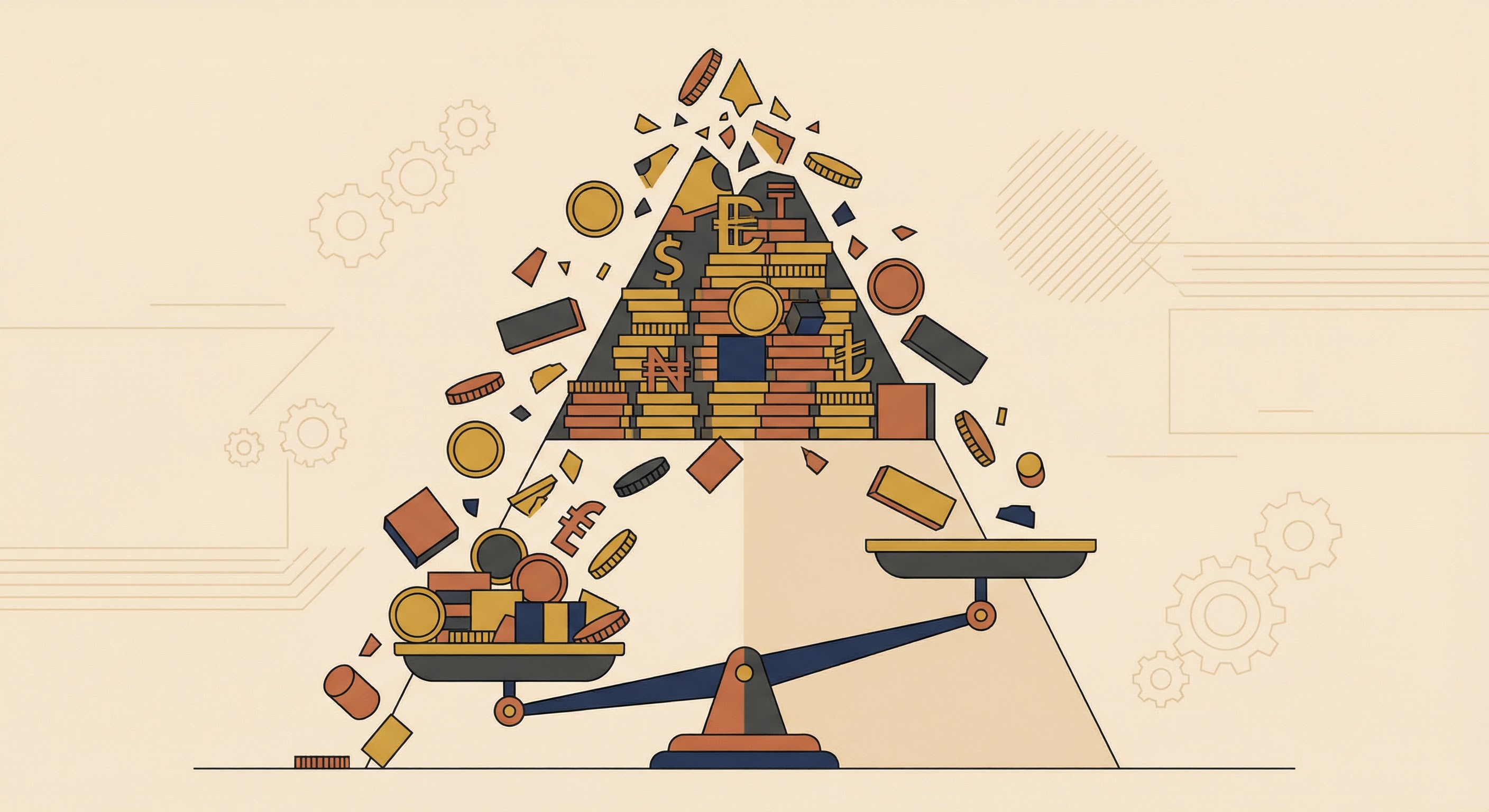
In 2024, the United States government spent more on interest payments than on national defence for the first time in its history. Net interest on the federal debt reached 881 billion dollars — surpassing the 874-billion-dollar defence budget — and by 2025 had climbed to 970 billion, closing in on the trillion-dollar threshold. The most powerful military in the history of the world now costs less to maintain than the interest on the borrowing that was, in part, used to build it. This is the kind of milestone that ought to concentrate minds. It has not. Congress continued to pass spending bills. The Treasury continued to auction bonds. The Federal Reserve continued to manage the consequences. The prevailing attitude in Washington — shared, it must be said, by both parties — is that sovereign debt is a problem for another decade, another administration, another generation. There is always a war to fund, a crisis to bail out, a voter base to placate. The bill is sent forward.
Philip II of Spain would have recognised the instinct immediately. He commanded the largest empire the world had ever seen, drew the silver of Potosí and the gold of the Americas into his treasury, and still managed to go bankrupt four times — in 1557, 1560, 1575, and 1596. The man had a literal mountain of silver and could not make the sums add up. One rather suspects that if Philip had been offered a credit card, he would have maxed it out funding the Armada and then applied for a second one to cover the minimum payment on the first. He is not the exception in the history of great-power finance. He is the template.
Every great power has followed the same fiscal arc: borrow to build, borrow to fight, borrow to sustain, and eventually discover that the interest on the borrowing has consumed the capacity to do any of it. The names change — Rome, Spain, France, the Ottoman Empire, Britain — but the arithmetic does not. Compound interest does not care about your civilisational achievements, your military victories, or your reserve currency status. It simply compounds.
US Federal Interest Payments vs. Defence Spending (1900–2026)
For a century, interest on the national debt was invisible — a rounding error next to the defence budget. In 2024, for the first time in American history, it exceeded it
Source: Historical Statistics of the US; OMB; CBO; US Treasury (FRED)
The Debt Cycle in History
The pattern is so consistent across centuries and continents that it begins to look less like coincidence and more like a law.
Spain is the ur-example of imperial fiscal collapse. Between 1500 and 1650, approximately 181 tonnes of gold and 16,000 tonnes of silver flowed from the Americas to Seville — wealth on a scale without precedent in European history. The Crown was nevertheless perpetually insolvent, because it spent the silver faster than the ships could carry it. The wars in the Netherlands alone consumed roughly twenty per cent of Crown revenues for eight decades — a rolling commitment that would have bankrupted far wealthier states. Philip II’s borrowing costs were ruinous: the Genoese and German bankers who financed his wars charged interest rates that compounded the problem with every new loan. Each default raised the cost of future borrowing; each rise in borrowing costs required still more revenue; each attempt to raise revenue — higher taxes in Castile, currency debasement, forced loans from merchants — weakened the domestic economy and drove capital abroad. By the mid-seventeenth century, Castilian peasants paid some of the highest tax rates in Europe while the economy contracted around them. The empire was hollowed from the inside. Carmen Reinhart and Kenneth Rogoff, in This Time Is Different, use Spain as the paradigmatic case of serial default: six sovereign bankruptcies between 1557 and 1647, each one eroding the credibility that would have made the next one avoidable.
France before the Revolution illustrates how fiscal crisis becomes political revolution. By 1789, debt service consumed approximately sixty per cent of royal revenues. The Seven Years’ War and France’s intervention in the American Revolution had together added 1.3 billion livres to the debt — a sum so large that servicing it devoured most of the Crown’s income. The structural problem was who bore the burden: the nobility and clergy were substantially exempt from direct taxation, so the weight fell on the Third Estate — the merchants, artisans, and peasants who composed ninety-seven per cent of the population but controlled a fraction of the wealth. When Louis XVI convened the Estates-General in May 1789, he was not seeking political reform. He was seeking permission to raise taxes, because the alternative was default. The storming of the Bastille, two months later, was downstream of the interest payments on the debt that France had incurred to help George Washington win American independence. History is rather fond of such ironies.
The Ottoman Empire followed a more genteel version of the same arc. By 1875, the Sublime Porte could not meet its debt obligations. The creditors — largely British and French banks — imposed the Ottoman Public Debt Administration, which effectively took control of significant Ottoman revenues. Foreign bankers were running the treasury of a sovereign empire. The Ottomans had borrowed their way from imperial sovereignty to supervised insolvency in barely a generation. The debt did not cause the empire’s dissolution — that required a world war — but it ensured that the empire entered the twentieth century with its finances controlled by the very European powers it would soon be fighting.
Britain after 1945 managed the problem with greater sophistication but no less pain. National debt stood at approximately 250 per cent of GDP — higher, relative to the economy, than the United States today. Britain did not default. Instead it used what economists call “financial repression”: keeping interest rates below the rate of inflation for three decades, which slowly eroded the real value of the debt at the expense of savers and bondholders. The empire was dismantled — not primarily for ideological reasons, though those mattered, but because it had become unaffordable. India, Palestine, Malaya, Kenya, Aden — one by one the commitments were shed. By 1976, Britain was seeking an emergency bailout from the International Monetary Fund. The debt-to-GDP ratio eventually fell below fifty per cent by the early 1990s, but the price was the loss of great-power status itself.
Rome debased by dilution rather than default. Between Augustus and Diocletian — from 27 BC to AD 284 — the silver content of the Roman denarius fell from approximately ninety-five per cent to under five per cent. The empire’s costs exceeded its revenues; successive emperors stretched the coinage to cover the gap. The result was inflation, collapse of long-distance trade, and the fiscal crisis of the third century that nearly destroyed the empire. The currency was debased because the alternative — raising taxes or cutting the legions — was politically impossible. The soldiers had to be paid. The empire had to be defended. The coinage could be quietly diluted. Nobody voted for it. Everybody paid for it.
Government Debt-to-GDP Ratio: Major Economies (1900–2025)
The debt mountain has been growing for a century — peacetime borrowing now rivals wartime levels
Source: IMF Historical Public Debt Database; Reinhart & Rogoff (2009)
The Modern Debt Mountain
Global government debt surpassed one hundred trillion dollars in 2024 — roughly ninety-three per cent of global GDP. The United States alone carries approximately thirty-six trillion dollars in federal debt, or 124 per cent of GDP. The Congressional Budget Office projects this will reach 166 per cent by 2054, with net interest alone consuming 6.3 per cent of GDP. The federal government is currently adding roughly one trillion dollars in new debt every hundred days. To contextualise that velocity: the entire national debt accumulated from the founding of the Republic to the inauguration of Ronald Reagan in 1981 was approximately one trillion dollars. The United States now borrows that much in a quarter.
The composition of the debt matters as much as the quantity. An increasing share is held by foreign governments — roughly $8.5 trillion — with China and Japan the largest holders. This creates a mutual dependency: the United States needs foreign buyers to fund its deficits; foreign holders need the dollar to remain stable to preserve the value of their reserves. It is the financial equivalent of two people pointing guns at each other and calling it stability.
Japan carries approximately 260 per cent of GDP in government debt. Italy sits at 137 per cent, France at 112 per cent, the United Kingdom at 101 per cent. China’s official government debt is eighty-four per cent of GDP, but total debt including local government financing vehicles and state-owned enterprises exceeds three hundred per cent. The post-2008 financial crisis and the COVID-19 pandemic account for much of the acceleration. Central banks in the US, Europe, Japan, and the UK purchased trillions of dollars in government bonds through quantitative easing — essentially creating money to buy their own governments’ debt, a manoeuvre that would have struck Philip II as both brilliant and rather suspicious.
Net interest in the United States is projected to total $12.9 trillion over the next decade — more than the entire defence budget over the same period. A trillion dollars in annual interest is a trillion not spent on infrastructure, scientific research, education, or defence. It is a transfer payment from current and future taxpayers to bondholders — a claim on the productive output of citizens who were never consulted about the borrowing and who, in many cases, were not yet born when it was incurred.
Why This Time Might Be Different — or Not
The optimistic case has intellectual substance and should not be dismissed. Modern Monetary Theory argues that a government which borrows in its own fiat currency can never truly go bankrupt, because it can always create more currency. Insolvency is impossible; inflation, not default, is the binding constraint. Japan is the real-world test case: it has carried debt above two hundred per cent of GDP for over a decade with no default, no hyperinflation, and bond yields that remain among the lowest in the world. The Bank of Japan holds approximately fifty-three per cent of all Japanese government bonds — the central bank, in effect, lending money to its own government by creating it.
What Japan has experienced is not catastrophe. It is stagnation — GDP growth averaging roughly 0.7 per cent since 1991, real wages functionally flat for three decades, a population that is both shrinking and ageing. The debt has not exploded. It has smothered. Growth that should have compounded over thirty years did not materialise. If this is what “sustainable” sovereign debt looks like, the word requires substantial redefinition.
Niall Ferguson, in The Cash Nexus, argued that the history of sovereign finance is, at its core, a history of states borrowing their way out of the consequences of previous borrowing — a treadmill that accelerates until either the runner finds a new source of energy or collapses. When expenditure exceeds revenue, the difference must come from taxation, borrowing, or debasement. The first is politically painful. The second defers the problem. The third destroys the currency. Most governments choose the second for as long as possible and then resort to the third. The American dollar’s reserve currency status permits a fourth option that no previous empire enjoyed: export the inflation. When the Federal Reserve creates money to purchase Treasury bonds, the resulting inflation is shared with every country that holds dollar reserves or prices commodities in dollars. This is an extraordinary privilege — one that Charles de Gaulle called, with characteristic French precision, an “exorbitant privilege.” But it is a privilege sustained by confidence, and confidence is a wasting asset once debt-to-GDP ratios begin to suggest that the borrower may not be entirely serious about repayment.
Who Pays
Debt is not abstract. It redistributes wealth — from the future to the present, and from those with no political voice to those who do. The pattern repeats across centuries, but there is something uniquely corrosive about its modern form.
The Roman Debasement: Silver Content of the Denarius (27 BC – 300 AD)
Rome's currency lost 95% of its silver content over three centuries — the original quantitative easing
Source: Harl, Coinage in the Roman Economy (1996)
Strip away the jargon and sovereign debt is this: the generation that can vote today spending money that will be repaid by the generations that cannot vote yet — including those not yet born. It is the fiscal equivalent of raiding your child’s college fund for a weekend in Vegas and leaving a note that reads “you’ll thank me later.” No private citizen could get away with binding a stranger to a debt incurred for someone else’s benefit. Governments do it as a matter of routine. A parent who spent their children’s inheritance would be called irresponsible. A government that spends its children’s future tax revenues is called pragmatic. The euphemism does a great deal of work.
This is not merely imprudent. It is fundamentally unethical. Democracy is supposed to mean that those who bear the cost of a decision have a voice in making it. Sovereign borrowing inverts this principle entirely. The beneficiaries of the spending — today’s voters, today’s pensioners, today’s military contractors — have full democratic representation. The people who will service the debt for decades hence have none. A five-year-old has no MP, no congressman, no lobby. An unborn child has even less. The incentive structure is perverse by design: politicians face elections every four or five years and are rewarded for spending now. The bill arrives in twenty or thirty years, by which time the spenders are comfortably retired or comfortably dead. It is, if one is honest about it, a form of taxation without representation — the very grievance that started the American Revolution and, with a different accent, the French one.
In pre-revolutionary France, the tax burden fell on the Third Estate while the nobility held the debt and received the interest payments — a direct transfer from the productive poor to the rentier rich. The parallel to the present day is uncomfortably exact. The top ten per cent of US households hold approximately eighty-seven per cent of individually held government bonds; the bottom fifty per cent hold functionally none. Quantitative easing inflated the prices of assets — houses, shares, bonds — while wages remained flat. Those who owned property and equities became substantially richer. Those who owned neither saw their purchasing power eroded by the inflation that the stimulus eventually produced. The costs of the current debt accumulation will fall disproportionately on millennials and Generation Z — the generations entering the workforce and the housing market into the headwind of debt-servicing costs, asset inflation, and fiscal constraints they did not create. They are, in a precise historical sense, the modern Third Estate — bearing the heaviest burden with the least say in how it was incurred. The sweets have been eaten. The wrappers are all that remain.
History offers three exits from the debt trap. The British exit: managed decline — shrink your commitments to match your means, sell the empire, accept that you are no longer a great power. The price is measured in relevance and influence, not default. The French exit: revolutionary upheaval — refuse to reform until reform is impossible, at which point the fiscal crisis metastasises into political collapse. The Japanese exit: slow stagnation — monetise the debt, suppress interest rates, hope the population is too old and too polite to complain. Nothing is resolved. Nothing visibly breaks. Nothing grows.
The United States possesses the dollar’s reserve currency status, which allows it to borrow more cheaply and for longer than any other nation in history. But this is a privilege, not a physical law, and it depends on the continued willingness of foreign governments and investors to fund American deficits. That willingness is a function of confidence — and confidence, once lost, does not return gradually. It vanishes.
Philip II had the silver of the Americas. Louis XVI had the richest kingdom in Europe. The Ottomans sat astride the trade routes of three continents. None of it was enough to outrun compound interest. The historical pattern is as clear as any pattern in economics can be. The only question is which exit the modern West will take — and whether its leaders will choose, or have the choice made for them. Send that to anyone who still thinks the deficit is someone else’s problem.