On the eve of the First World War the entire British state — army, navy, empire, courts, schools, roads, poor relief, the lot — cost a little over twelve per cent of national income.
Today social security and health alone cost twenty-two per cent. Two line items now consume nearly twice what the whole of government consumed in 1913.
Part of the reason is straightforward and creditable: Britain decided to look after its people properly, and did. But that is not the whole reason, and the missing half is the more interesting one. Britain also acquired a household problem, and the state was the only institution left standing that could pick it up.
Because the caring did not appear out of nowhere in 1948. It was always being done. It was simply being done at home, for nothing, by women, and it never appeared in any account of national expenditure because nobody was paid.
I. Twenty Shillings a Month
For three and a half centuries, looking after your own family was not a moral expectation in Britain. It was a legal duty, and you were fined for neglecting it.
The Elizabethan Poor Law of 1601 is remembered for the workhouse, which came later, and for parish relief, which was real but small. Its central clause did something quite different: it named the relatives legally obliged to support a person who could not support themselves.
“And be it further enacted, That the Father and Grandfather, and the Mother and Grandmother, and the Children of every poor, old, blind, lame, and impotent Person or other poor Person not able to work, being of a sufficient Ability, shall, at their own Charges, relieve and maintain every such poor Person.”
Read that as the instruction it was. If your mother could not work, you had to keep her — at your own expense, whether you wanted to or not. Magistrates at Quarter Sessions assessed what you could afford and set the amount you would pay. If you failed to pay it, you forfeited twenty shillings for every month of default, which was several weeks’ wages for a labourer.
The obligation ran upwards two generations, to parents and grandparents, and downwards one, to children. Not siblings, not cousins, and — in a mercy the Elizabethans had presumably given some thought to — not in-laws. A named, enforceable circle of five, with a court behind it.
That was the British welfare state, and it was funded out of families’ own pockets under threat of a fine.
Parish relief existed for those with nobody left, and it was not trivial — in 1803 some 1,041,000 people, 11.4 per cent of the population of England and Wales, received it, at a cost of 1.9 per cent of national income, peaking at 2.7 per cent in 1818-20. But the sequence mattered: the parish paid only after a family had been assessed and found genuinely unable to. The taxpayer was the last resort, not the first.
Between family and parish sat the friendly societies, which is the part of British welfare history that has been most thoroughly forgotten. By 1900 there were somewhere between 5.8 and 6.3 million memberships in registered friendly societies in Great Britain — men paying a few pence a week into mutual funds that covered sickness, medical attendance and burial. Not charity, and emphatically not the state. Insurance, bought by the working class from institutions it owned.
Britain in 1913 spent twelve and a half per cent of national income on government because it did not need to spend more. The care was happening. It was simply happening in kitchens and front rooms and at the meetings of the Ancient Order of Foresters.
II. The Great Transfer
The Whole State Used to Cost Less Than Care Does Now
UK public spending was 13.8 per cent of GDP in 1913-14. Social protection and health alone are 21.7 per cent today
Source: Office for Budget Responsibility, Historical Public Finances Database, 20 July 2023 (public sector series, financial years; pre-1900 figures are central government only and are not shown); HM Treasury, PESA 2026, 16 July 2026 for 2025-26. The two series are not fully independent — the Office for Budget Responsibility takes 1900 onwards from the Bank of England
The system had one structural requirement, and two wars destroyed it: it needed the family to be intact, and somebody in it to be at home.
The first cracks appeared before either war. The Old Age Pensions Act of 1908 paid five shillings a week from the age of seventy, means-tested and non-contributory, and it was aimed with some precision at the person the 1601 Act could not help: the old man or woman whose liable relatives were already dead. It could be forfeited for habitual drunkenness, or for “habitual failure to work according to his ability, opportunity, and need” — a clause that must have given magistrates a good deal to think about.
Its effect on the national arithmetic was immediate. The 1911 census in Scotland found a distinct bulge in the number of people declaring themselves to be seventy, and its compilers observed that “the passing of the Old Age Pensions Act… is not unconnected with it.”
The National Insurance Act of 1911 followed, compulsory for employed persons, seven pence a week for men against sickness and disability. Both were built alongside the friendly societies rather than against them; the 1911 Act ran its health insurance through them.
Then came the First World War, and Britain buried roughly three quarters of a million of its servicemen — around 880,000 counting the wider Empire, the great majority of them young men who would otherwise have spent the next forty years earning.
Consider what that does to a system of legal family maintenance. Every one of those deaths removed a son who would have been liable for his parents in their old age, or a husband whose widow now had children to raise and nobody earning. The Elizabethan circle of five assumed the circle existed. After 1918 hundreds of thousands of British families had a gap in it where the wage-earner should have been, and no amount of magistrate’s assessment could conjure maintenance out of a man buried in France. The obligation remained on the statute book; the people who were supposed to discharge it were dead. The demographic and social consequences of losing that generation ran far wider than the war memorials suggest — and the growth of the state was one of them.
The Second World War completed the job from the other direction. It put women into factories, shipyards, offices and fields in numbers that had no precedent, and it demonstrated to a generation of them that they were capable of paid work and could be paid for it. Many did not go back. The household had lost the men who were supposed to fund it; now it began losing the women who had actually been doing the caring.
Both trends have continued ever since, and the divergence between men’s and women’s lives that followed is one of the defining social facts of the last century. Female labour force participation was 55.5 per cent in 1971 and is 75.6 per cent now. Every one of those twenty points is a woman doing something valuable that is not nursing her own mother during working hours — and a state that acquired the job by default.
Beveridge wrote in the middle of all this. In November 1942 he named the five giants — “Want is one only of five giants on the road of reconstruction and in some ways the easiest to attack. The others are Disease, Ignorance, Squalor and Idleness” — and proposed a flat-rate universal scheme to fight them all. He was not inventing the welfare state so much as nationalising a service the family could no longer supply.
What happened next is best measured by a single date.
On 5 July 1948 two things came into force. The National Health Service began, and the poor law was abolished. Section 1 of the National Assistance Act reads: “The existing poor law shall cease to have effect.” Two statutory instruments, one appointed day, and three hundred and forty-seven years of legal family liability came to an end.
Not entirely. The 1948 Act narrowed the obligation rather than removing it: parents, grandparents and adult children were released, but spouses and children under sixteen remained liable. The 1601 Act itself, having stopped doing anything in 1948, sat on the statute book for a further nineteen years and was finally repealed by the General Rate Act 1967.
The narrowed obligation, meanwhile, is still there. The Social Security Administration Act 1992, section 78(6), makes you liable for your spouse and your minor children to this day. Parliament legislated to abolish it in 2012 and has not yet got round to switching the abolition on. The Elizabethan circle of five became a circle of two, and stayed there.
The accounts record the handover precisely. Health spending does not appear in the British public finances as a measurable category until 1920-21, when it is 0.71 per cent of GDP. There was no line for it, because there had been nothing to record. It is now 8.4 per cent. A social security series does not begin until 1955-56.
III. What the State Actually Buys
Nearly Half the British State Is Care
Social protection and health together take £664.8bn — 48.9 per cent of all public spending, and more than four times the defence and public order budgets combined
Source: HM Treasury, Public Expenditure Statistical Analyses 2026, published 16 July 2026, Table 5.2. Total managed expenditure 2025-26 outturn was £1,360.1bn; functional shares are of that total. Defence is the UN COFOG definition, which is not comparable with NATO-qualifying spend. Debt interest is central government debt interest proper, not the wider £130.3bn public debt transactions line
Set aside the arguments about waste and efficiency savings for a moment, and look simply at what Britain buys.
Total managed expenditure in 2025-26 was £1,360.1 billion, or 44.3 per cent of GDP. Of that, social protection took £407.3 billion and health £257.5 billion. Together, £664.8 billion — 48.9 per cent of everything the state spends.
Nearly half the British state is care. The state pension alone is £136.6 billion, a tenth of all public spending. Education is £125.7 billion. Defence, on the international accounting definition, is £65.4 billion — less than half of what the state pension costs. Debt interest proper is £96.9 billion.
Set the two care lines against the historical benchmark and the shape of the last century becomes obvious. Social protection and health are 21.7 per cent of GDP. The whole British state in 1913, including a navy that ruled the world, was 12.5 per cent.
This is not a story about a government that lost control of its budget. It is a story about a government that took delivery of an enormous quantity of work it had never previously done, and then discovered that the work grows with the age of the population. Which is why the debt trajectory looks the way it does: the Office for Budget Responsibility, the Treasury’s independent forecaster, has age-related spending going from 26.3 per cent of national income to 34.5 per cent by 2075-76, and public debt to roughly three times national income.
Every serious proposal for fixing this either raises taxes on a shrinking working population or cuts benefits for a growing retired one. Both are arguments about how to divide a fixed quantity of care between people who cannot pay for it.
Nobody argues about whether the quantity is fixed.
IV. The Welfare State That Was Never Nationalised
The Welfare State That Was Never Nationalised
Unpaid carers deliver care worth almost as much as the entire NHS. What councils spend on adult social care is a fraction of either
Source: Unpaid care: Petrillo, Zhang and Bennett, Valuing Carers 2021/22, Centre for Care, 21 November 2024 (UK, replacement-cost basis, reference year 2021/22), against the four-nations NHS budget of £189bn for the same year as stated in that report. Council spend: DHSC, Adult social care finance report, England: 2024 to 2025 (gross current expenditure, England only). Note the geographies and years differ — the comparison is indicative of scale, not like-for-like
Here is the part that ought to change the conversation, and almost never enters it.
The household never stopped. In England and Wales, five million people were providing unpaid care at the 2021 Census, and 1.5 million of them were doing fifty hours a week or more. Fifty hours is more than a full-time job, performed without wages, holiday, sick pay or pension, largely by people in their fifties and sixties looking after parents in their eighties.
Valued at what it would cost to buy, that care came to £184.3 billion a year across the United Kingdom — against a four-nations NHS budget of £189 billion. The unpaid carers of Britain deliver something within three per cent of the entire National Health Service, and appear in no budget, no manifesto and no productivity statistic.
Widen the lens from care to everything households do for themselves — cooking, cleaning, laundry, childcare, ferrying people about — and the Office for National Statistics puts the value of unpaid household services at £1.7 trillion, sixty-one per cent of GDP. The unmeasured economy is roughly three-fifths the size of the measured one.
That number is the hinge of this entire argument, so it is worth being precise about what it means. The state’s care bill is not the cost of caring for Britain. It is the cost of the fraction of caring that households can no longer absorb. Local authorities spent £29.4 billion on adult social care last year supporting 890,000 people, while five million people cared for nothing. The state is the overflow, not the system.
Which means the state’s bill is not driven by how much care Britain needs. It is driven by how much care the household can do — and that is a variable, not a constant. It fell for a century as women went out to work, families dispersed and 8.6 million people ended up living alone, roughly half of them over sixty-five.
Raise it and the overflow shrinks. Nobody has been able to raise it since 1911.
V. The Robots Come Home
Britain has done this before, within living memory, and forgotten that it happened.
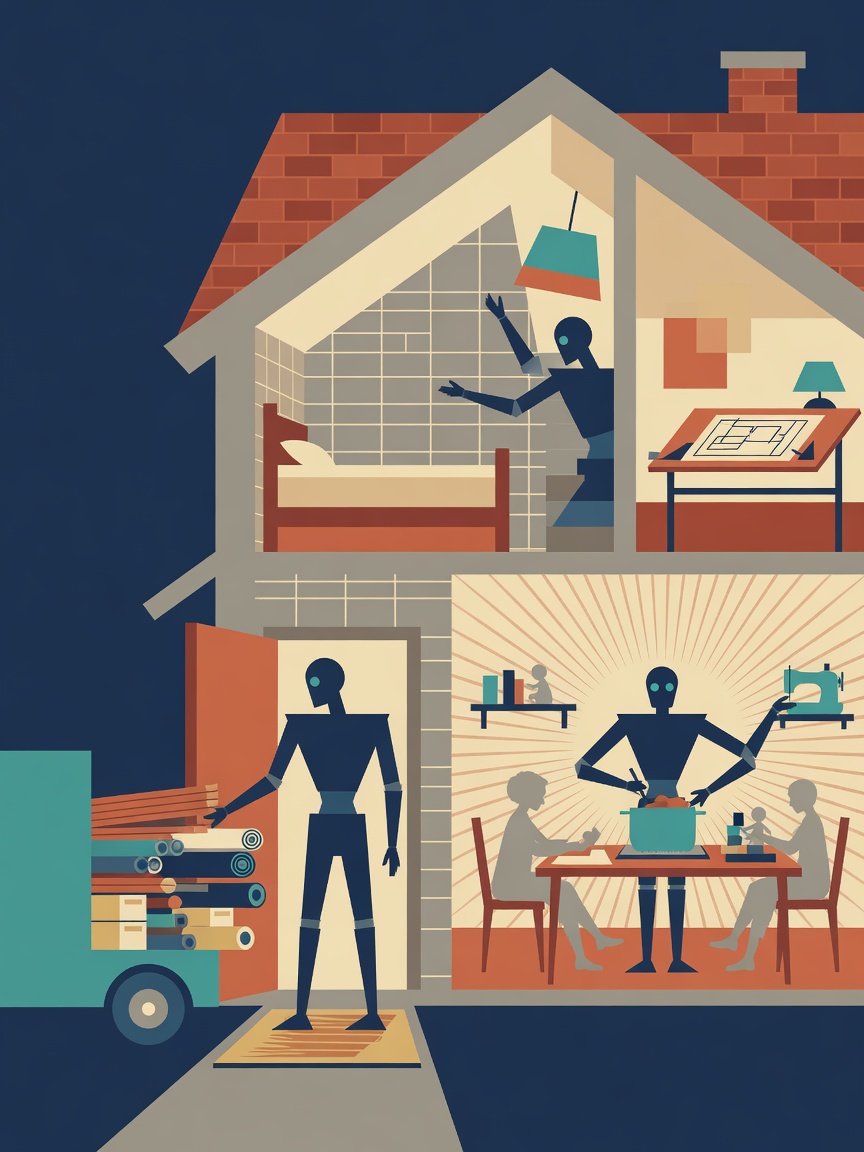
Until the middle of the twentieth century Monday was washday. Not an idiom — a fact of the week’s structure. Laundry for a family meant hauling and heating water, a copper boiler, a mangle, and the better part of a day’s labour, every week, performed by a woman who had other things to do. The washing machine abolished that day. There was no white paper on it, no ministerial statement, no debate about the future of domestic labour. Households bought machines because the machines were obviously worth having, and an institution as old as the week ceased to exist.
The refrigerator did the same to food preservation, the vacuum cleaner to sweeping, the dishwasher to washing-up. Each took a block of work a person had been doing by hand and reduced it by an order of magnitude. Nobody experienced any of it as a transition, because the transition arrived as shopping.
What has not yielded is everything that needs a person rather than a motor.
That distinction is the whole argument, so it is worth being concrete. A washing machine washes clothes; a person still has to sort them, load them, hang them, fold them and put them away. A dishwasher cleans plates; a person clears the table and stacks it. Nobody has ever built an appliance that cooks a meal from raw ingredients, changes a bed, helps a frail woman out of a bath, fetches her tablets at the right hour, notices that she is unsteady today, or sits with her. All of that is done by human beings now — mostly unpaid, mostly by women, mostly by daughters in their fifties looking after mothers in their eighties.
A humanoid robot is the first thing capable of doing those jobs, and the reason is simply that it has the shape and the senses of the person currently doing them. It is not a better appliance. It is a general-purpose worker in a house built for general-purpose workers, able to pick things up, climb stairs, use a kettle and a washing line, and understand an instruction it has not been given before. That is why the argument is about robots rather than about gadgets: the work that remains is human-shaped, and until now the only thing human-shaped enough to do it was a human.
The order in which it arrives is fairly predictable. Cooking, cleaning and tidying first, because the tolerance for error is low but not dangerous. Then monitoring and reminding, which turns an elderly relative living alone into a person whose medication, movement and overnight breathing are watched continuously rather than checked on Sundays. Then, last and hardest, the physical work of care: lifting somebody out of a bath, helping them dress, getting them to the lavatory at three in the morning.
VI. Why It Gets Cheap
Three things make the economics of a household robot unusual, and the third is the one almost everyone misses.
A household robot substitutes for services bought at retail prices — restaurant meals, cleaners, tradesmen, childcare, and eventually care workers at £32 an hour. Its return is measured against the most expensive available way of buying the work.
Robots make robots cheaper. Roughly two thirds of the cost of any manufactured good is embedded labour — in the factory that made it, the factory that made that factory’s tools, and the logistics between. Automate those and the robots themselves get cheaper, which lowers the cost of everything they make, including the next generation of robots.
And work done at home is untaxed. This is the channel that turns a household saving into a fiscal one. If you pay a carer £32 an hour, that £32 carries income tax, National Insurance from both employee and employer, and the provider’s margin and VAT on top; you must earn perhaps £50 before tax to buy it. If your robot does the same hour, the transaction does not exist. No wage, no payroll, no invoice, nothing to tax and nothing needing to be taxed. Household production is invisible to the Treasury in both directions — it collects nothing on it, and it does not have to fund it. The £32 hour that becomes an untaxed hour at home is not a £32 saving to the household. It is closer to £50 of gross earnings that nobody now has to make.
Work that through a household budget sector by sector — food, housing, energy, transport, goods, services — and the technical floor on the cost of living lands somewhere around a quarter of today’s. On that arithmetic a household eventually needs something like £10,000 to £13,000 a year to live at what is currently the median standard.
Two cautions belong with that figure, and the second is the serious one. It is a technical floor, describing what things cost to produce rather than what they are sold for; concentrated ownership of the robots, the energy or the models would hold prices well above it and take the difference as rent. And the timeline is long — a humanoid robot you can actually buy in 2026 costs about $13,500, manages a two-kilogram payload and runs for two hours, which makes it a research platform rather than a carer. The direction is not in doubt. The date is.
The fuller version of this argument, and what it does to a single household year by year, is set out elsewhere. What matters here is that the same robots, doing the same work, land on the state’s accounts as well as the household’s.
VII. Four Ways the Bill Falls
The fiscal effect works through four separate channels, and they are frequently confused with one another.
The obvious channel is substitution. A robot that manages medication, watches overnight, lifts someone from a bed to a chair and prepares food to a clinical diet does work currently costing £908 a week in a local-authority residential place, or £32.14 an hour bought in at home. The margin against a robot is enormous, and it accrues to whoever owns the robot.
The second channel is the one that actually matters, and it is not about replacing carers at all. It is about the 1.5 million people doing fifty hours a week. A robot that turns fifty hours into fifteen does not save the state a penny directly — that care was already free. What it does is stop the carer giving up her job, stop her own health collapsing, and stop the moment when she can no longer cope and the whole package lands on the local authority at £47,000 a year. The state’s saving comes from care that never enters the system.
The third is that people need less money. Every benefit indexed to the cost of living is a promise denominated in a number that robots push down. Pensions, universal credit, housing support, pension credit: the same nominal payment buys more, or a smaller payment suffices. Social protection is £407 billion of transfers whose adequacy is defined by what a household must spend to live.
The fourth compounds the third, and it is the one that never gets counted. Work moved into the home leaves the tax system entirely. An hour of care bought in costs £32, of which a substantial part is income tax, National Insurance and VAT, and which somebody must earn perhaps £50 before tax to afford. The same hour done by a robot in the house generates no wage, no payroll and no invoice. The state loses the tax it would have collected on that transaction — but it also loses the obligation to fund it, and the household needs a smaller gross income to reach the same standard of living. Lower costs mean lower benefits, lower benefits mean lower spending, and lower required earnings mean less tax has to be raised in the first place.
All of it points the same way. The amount of money people need falls; the amount the state must supply falls further, because the household absorbs work it had handed over; and the amount of tax that must be collected to fund what remains falls with both.
VIII. What Comes Back Home
Take the three biggest lines in turn.
Pensions. The state pension is a cash transfer, so no robot reduces it directly. What changes is what the money must cover. A pensioner whose home produces much of its own food, energy and maintenance, and whose care needs are met in place rather than in an institution, needs a materially smaller income to live decently. The £136.6 billion does not fall by fiat; it stops needing to rise as fast, which over fifty years is the same thing.
Health. The expensive part of healthcare has never been diagnosis. It is the labour of looking after people afterwards, and the most expensive version of that labour is the one that happens in a hospital bed because there is nowhere else to go. On any given day in January 2026 an average of 13,750 patients were medically fit to leave hospital and could not. Almost all of them were waiting for care that a household with a robot in it could have provided.
Social care and unemployment support. These are the lines where the household’s capacity is most directly substitutable, and where the current system is most obviously a rationing exercise. Councils pay homecare providers an average of £23.26 an hour against an industry minimum price of £32.14 — a gap of nearly nine pounds an hour, which providers absorb by paying staff less and recruiting fewer of them.
None of this requires the state to do anything clever. It requires households to become more capable and then get out of the way, which is the direction of travel regardless of policy.
IX. The Street Fight: England Already Ran This Experiment and It Failed
Japan Bought Monitoring, Not Hands
Daily use in Japanese residential care facilities. Sensors are near-universal; the robots that would actually move a person sit below ten per cent
Source: Care Work Foundation, Survey on Actual Conditions of Care Work FY2024, published 28 July 2025. Fieldwork October 2024; 9,044 establishments responded; robot and ICT table base n=8,978
An honest version of this argument has to confront the fact that it has been tried, in England, under randomised conditions, and did not work.
Between 2008 and 2011 the Department of Health ran the Whole System Demonstrator — the largest trial of telecare and telehealth ever conducted anywhere, with roughly six thousand participants across Cornwall, Kent and Newham. The proposition under test was precisely the one above: that technology in the home reduces demand on health and social services.
The results were unambiguous, and they went the wrong way. Telecare produced no statistically significant reduction in hospital admissions, social care use, mortality, GP contacts or residential care. Nothing moved.
Its cost was worse than its ineffectiveness. The standard test of whether the health service should buy something is what it pays for each additional year of life in good health that the thing delivers; the National Institute for Health and Care Excellence reckons anything beyond £20,000 to £30,000 a year to be poor value. Telecare came out at £297,000 — roughly ten times the threshold. Telehealth, which monitored vital signs rather than raising alarms, did better on mortality and worse on everything else, at £92,000 a year and with an accompanying study concluding it “was not effective or efficacious compared with usual care only.”
Nor is the wider record encouraging. No developed country has ever reduced health spending as a share of GDP through technology. The Office for Budget Responsibility’s own modelling treats technology as a net addition to health cost growth, projecting British health spending from 7.9 to 14.5 per cent of national income by 2073-74 — and William Baumol’s cost disease supplies the reason, since wages in labour-intensive personal services must track the wider economy whether or not productivity moves. Britain’s existing telecare estate, on which some 1.7 to 2 million people depend, is meanwhile being degraded by the analogue telephone switch-off: Ofcom fined Virgin Media £23.8 million in December 2025 for failing to protect vulnerable telecare customers during migration.
So the sceptical case is strong, evidenced, and British. It deserves an answer rather than a wave.
The answer is that the trial looks like a test of this argument and is not one. The resemblance is real, and it is superficial. What the Whole System Demonstrator put in people’s homes and what is being described here are different categories of thing, and the difference is the whole point rather than a quibble.
Consider what a participant in that trial actually received. A pendant to press if they fell. A box that measured blood pressure and sent the reading to a monitoring centre. Sensors that reported movement, or its absence. Every one of those devices performs exactly one function: it tells somebody else that something is wrong.
None of them lifts, washes, cooks, dresses, or sits with anybody. Not one of them did a single thing that a carer does.
So the trial answered a narrower question than it appeared to, and answered it correctly: does better information reduce the demand on health and social care? No — because the binding constraint on care has never been information. It is hands. A system already short of people, given more alerts about people needing help, produces more alerts and the same shortage, and a bill for both. A £297,000 cost per year of healthy life is what that looks like when it is costed honestly.
What is proposed here is not a better pendant. It is a machine that does the washing, the cooking, the lifting and the sitting-with — that is, the labour itself, which is where essentially all of the money goes. Telling a household that its grandmother has fallen and putting something in the house that stops her falling are not two versions of the same intervention. The first is surveillance. The second is a carer.
Japan has run the same experiment at national scale and produced the same split. In Japanese residential care facilities, bed sensors are used daily in 70.1 per cent. Transfer-assistance robots — the ones that would actually move a person — are used in 6.2 per cent. Every category of care robot sits below ten per cent. Japan bought monitoring, because monitoring was purchasable. The hands were not for sale.
They are still not for sale, and this is where the honest version of the argument has to concede the timing. What you can buy in 2026 is not close. A Unitree G1 humanoid costs about $13,500 and has a two-kilogram arm payload and two hours of battery; it cannot lift a full kettle, let alone a person. Tesla has sold no Optimus units to any external customer. The most advanced home humanoid taking pre-orders, 1X’s NEO, is documented on the company’s own website as being piloted remotely by human operators — which is to say that the robot, for now, has a person inside it.
The claim is therefore not that this is happening. It is that the thing which failed the trial and the thing now becoming possible are different things, and that the first tells you very little about the second. Monitoring was tested and did not save money. Substitution has never been tested, because until approximately now there was nothing to test.
X. The Catastrophe Is Conditional
Which brings us back to the arithmetic that opened this, and to the debt Britain is passing to its children.
Every projection of fiscal doom rests on an assumption so deeply buried that it is rarely stated: that the amount of care a household can perform for itself is fixed at its present level, and that all future growth in need must therefore be met by the state, from taxes, on borrowed money. Feed that assumption fifty years of demography and you get debt at three times national income, and the choice between taxing the young into emigration and abandoning the old.
The assumption is false, and it has been false before. The household’s capacity is not a constant. It was very high in 1601, when the law simply assumed a family would maintain its own grandmother and fined it twenty shillings a month if it did not. It fell for a century, as work left the home and women left with it, and the state stepped into the gap it left. Almost the whole growth of the British state from twelve per cent of GDP to forty-four is that single substitution, running one way.
Nothing says it only runs one way.
If households become capable again — and cheap capable robots are the only mechanism by which they plausibly could — the overflow shrinks from both ends. People need less money because things cost less. The state supplies less care because the household absorbs more of it. Neither depends on a minister deciding anything, and neither will be announced.
The forecasts, then, are not predictions. They are extrapolations of a one-way transfer that ran from 1908 to 1948 and has never been asked to reverse. Britain’s debt is a bill for work the family stopped doing. Hand the work back with better tools than the family ever had, and the bill was never the destiny it is currently being described as.
The robot does not age, does not tire, and does not need to be fined twenty shillings a month to make it help. It is the first thing in four hundred years capable of doing what the Elizabethans simply assumed a daughter would do.